Headlines
SC rejects plea for Constitution Bench on Ayodhya dispute
New Delhi, Sep 27
By a majority 2-1 judgement, the Supreme Court on Thursday rejected a plea for referring the Ramjanambhoomi-Babri Masjid issue to a larger Constitution Bench and referred the case to a three-judge bench to be set up that will begin hearing from October 29."No case has been made out to refer the case to a Constitution Bench," said Justice Ashok Bhushan, reading the judgement on behalf of himself and Chief Justice Dipak Misra, who headed Thursday's three-judge bench.
The bench was giving its verdict on petitions by some Muslims who had pleaded that the 2010 judgement of the Allahabad High Court splitting the title dispute into three parts be heard by a Constitution Bench as it involved reconsideration of a 1994 ruling by a five-judge bench of the apex court which had held that mosque was not an essential part of Islam to offer namaz.
The petitioners had contended that while deciding the title suit in 2010, the Lucknow bench of Allahabad High Court had referred to the observations made in the 1994 judgement by the five-judge bench.
However, in a dissenting ruling, Justice Abdul Nazeer said the judgement in the 1994 Ismail Farooqi case needed reconsideration and the matter should be referred to a larger seven-judge bench.
The majority judgement on Thursday held that a newly constituted bench will commence hearing from October 29 on a batch of petitions filed by both the sides -- Hindu and Muslim stakeholders -- challenging the 2010 judgement trifurcating the disputed site into three parts for Ram Lalla, Nirmohi Akhara and the original Muslim litigant.
"Observations in Ismail Farooqi case on mosques not being essential to religion was in the context of acquisition of mosque and made with respect to facts of that case. The observation made in Ismail Farooqi case has to be treated as only observation and not as the deciding factor of suit," Justice Bhushan observed.
In his minority judgement, Justice Nazeer said "questionable" observations in the Ismail Farooqi ruling were arrived at without undertaking a comprehensive examination and they had permeated the judgement in the main Ayodhya title suit.
He said a Constitution Bench must decide what constitutes essential practices of a religion and thereafter the Ayodhya land dispute should be heard.
Justice Nazeer also said that whether mosque was an essential part of Islam for offering namaz was to be decided considering the religious beliefs and requires detailed consideration.
He also said that the question of the 1994 Ismail Farooqi judgement needed to be referred to a seven-judge bench.
The bench was giving its verdict on petitions by some Muslims who had pleaded that the 2010 judgement of the Allahabad High Court splitting the title dispute into three parts be heard by a Constitution Bench as it involved reconsideration of a 1994 ruling by a five-judge bench of the apex court which had held that mosque was not an essential part of Islam to offer namaz.
The petitioners had contended that while deciding the title suit in 2010, the Lucknow bench of Allahabad High Court had referred to the observations made in the 1994 judgement by the five-judge bench.
However, in a dissenting ruling, Justice Abdul Nazeer said the judgement in the 1994 Ismail Farooqi case needed reconsideration and the matter should be referred to a larger seven-judge bench.
The majority judgement on Thursday held that a newly constituted bench will commence hearing from October 29 on a batch of petitions filed by both the sides -- Hindu and Muslim stakeholders -- challenging the 2010 judgement trifurcating the disputed site into three parts for Ram Lalla, Nirmohi Akhara and the original Muslim litigant.
"Observations in Ismail Farooqi case on mosques not being essential to religion was in the context of acquisition of mosque and made with respect to facts of that case. The observation made in Ismail Farooqi case has to be treated as only observation and not as the deciding factor of suit," Justice Bhushan observed.
In his minority judgement, Justice Nazeer said "questionable" observations in the Ismail Farooqi ruling were arrived at without undertaking a comprehensive examination and they had permeated the judgement in the main Ayodhya title suit.
He said a Constitution Bench must decide what constitutes essential practices of a religion and thereafter the Ayodhya land dispute should be heard.
Justice Nazeer also said that whether mosque was an essential part of Islam for offering namaz was to be decided considering the religious beliefs and requires detailed consideration.
He also said that the question of the 1994 Ismail Farooqi judgement needed to be referred to a seven-judge bench.
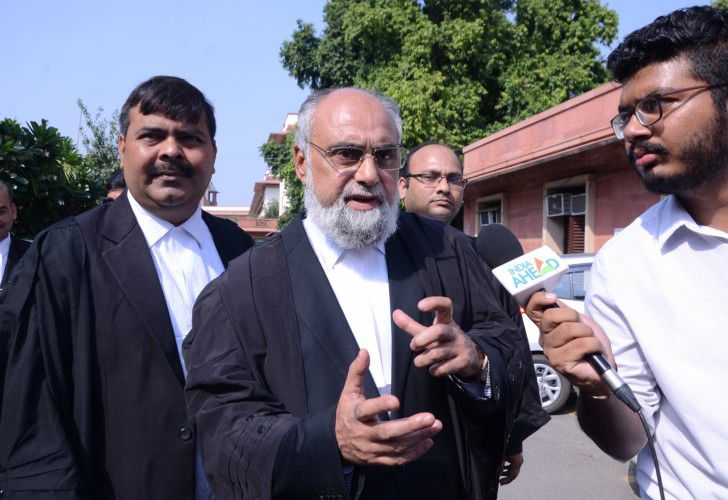
Senior advocate Shakeel Ahmed Syed, representing Sunni Waqf Board, talks to the media outside the Supreme Court, in New Delhi on Sept 27, 2018. The Supreme Court on Thursday rejected a plea for referring the Ramjanambhoomi-Babri Masjid dispute to a larger Constitutional Bench and decided that a newly set up three-judge bench will hear the case from October 29.

5 hours ago
Trump administration's 75-country immigrant visa ban struck down by US judge
5 hours ago
BRICS Youth Ministers approve joint statement in Visakhapatnam; delegates take part in 'Ek Ped Maa Ke Naam'
5 hours ago
Strengthening defence ties across Indo-Pacific: IAF concludes exercises in Australia, Malaysia
5 hours ago
US lawmakers criticise Trump tariffs after Canada trade talks collapse
5 hours ago
Israel informs US of possible Turkish radar deployment in Syrian airbase
5 hours ago
Canadian PM vows 'dollar-for-dollar' tariffs against US as trade talks collapse
5 hours ago
Pakistan's illegal organ trade spreads beyond borders, fueled by poverty, weak enforcement: Report
5 hours ago
Gujarat CM Bhupendra Patel highlights state’s growth vision during New Jersey visit
5 hours ago
Two crew members rescued after cargo ship sinks off Odisha coast; search for 22 on
5 hours ago
Received messages from neighbours about shaping new security, economic arrangements: Iran
5 hours ago
Egypt, Iran discuss efforts to resume diplomatic track for regional de-escalation
5 hours ago
Hungary's Paks nuclear power plant restarts Unit 3 as Danube water level rises
5 hours ago
Indian Railways emerges as world’s second-largest freight carrier; bulk cargo, electrification among key factors