




Business
Indian automakers face heat amid global constraints, hike prices
New Delhi, April 17
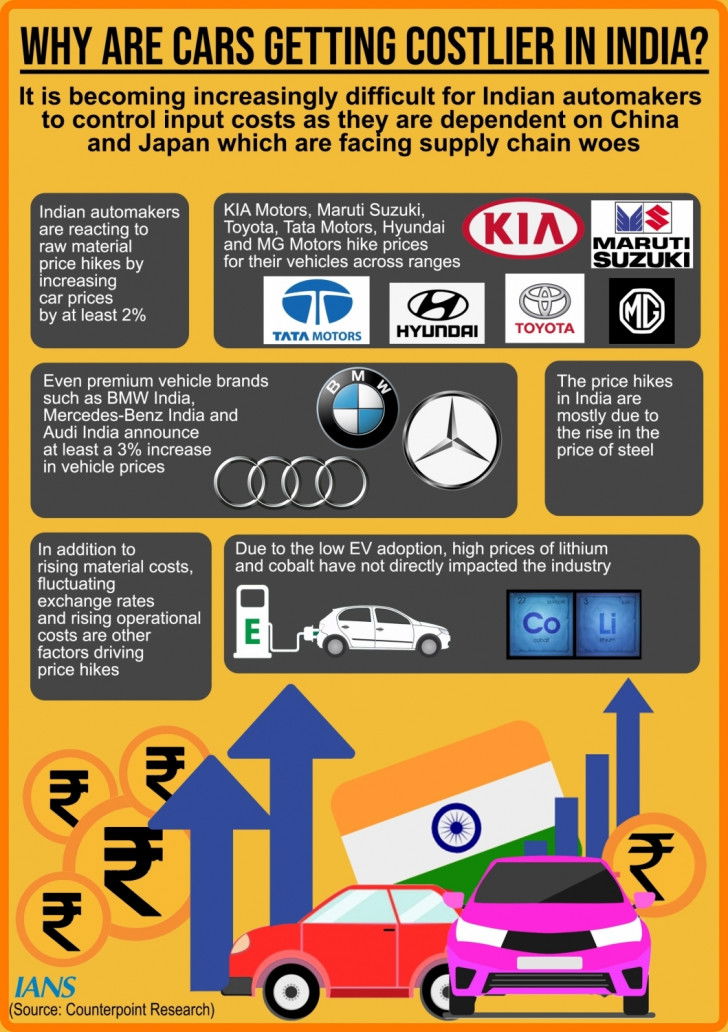
It is becoming increasingly difficult for Indian automakers to control input costs as they are dependent on China and Japan which are facing supply chain woes, resulting in price hikes across vehicle ranges, according to a new report.
Indian automakers are responding to raw material price hikes by at least 2 per cent price hike on average, according to Counterpoint Research.
KIA Motors has increased prices of all its vehicles. Maruti Suzuki, India's largest passenger vehicle (PV) maker, has also increased the average price of its cars by 8.8 per cent since January.
"Toyota, Tata Motors, Hyundai and MG Motors have also increased prices for their vehicles across ranges. Even premium vehicle brands such as BMW India, Mercedes-Benz India and Audi India have announced at least a 3 per cent increase in their vehicle prices," said Soumen Mandal, senior research analyst.
Due to the low electric vehicle (EV) adoption, high prices of lithium and cobalt have not directly impacted the industry in India.
"The price hikes in India are mostly due to the rise in the price of steel. Steel is used in manufacturing vehicle chassis and body. Nickel-containing stainless steel is used in some drivetrain components," Mandal added.
In addition to rising materials costs, fluctuating exchange rates and rising operational costs are other factors driving price increases in the country.
With the semiconductor shortage beginning to ease, 2022 was expected to be a better year, as indicated by increased sales during the initial months.
But Russia's invasion of Ukraine and fresh Covid waves in China have further delayed the industry's recovery.
"Restricted supplies of critical raw materials procured from Ukraine and Russia are causing new supply chain impacts, driving up raw material prices including that of lithium, cobalt and nickel -- the latter by 60 per cent -- as well as aluminium and, to some extent, steel," Mandal explained.
The recent cost increases have already affected the EV industry.
2021 saw EV sales rising by more than 200 per cent but price increases are likely to put the brakes on a continuation of this fast growth.
"For 2022, we expect global passenger vehicle sales will be around 72 million, some 5 million units lower than our earlier projections," said the report.
10 hours ago
Mohanlal-starrer 'Drishyam 3' makers to get Rs 100 crore investment from popular production house
11 hours ago
Beijing rejects Trump's claim that intercepted Iranian ship carried 'gift' from China
11 hours ago
Situation in Iran remains serious, Embassy providing assistance to Indian nationals: MEA
11 hours ago
Blockade tightens as US escalates Iran pressure
11 hours ago
Iran delegates to arrive in Islamabad tonight, reports Pakistan's ARY News
11 hours ago
MEA Secretary Sibi George discusses UN reform, Global South with Antonio Guterres
13 hours ago
Iran delegates to arrive in Islamabad tonight, reports Pakistan's ARY News
13 hours ago
Trump signals possible military action against Iran, says no rush for deal
13 hours ago
MEA Secretary Sibi George discusses UN reform, Global South with Antonio Guterres
13 hours ago
RSS model build on trust, teamwork: Dattatreya Hosbale
16 hours ago
SC orders reinstatement of Gujarat judicial officer with full benefits
16 hours ago
Denied mobile phone, K'taka boy commits suicide; police warn parents against abrupt withdrawal
16 hours ago
SC refuses to hear plea by West Bengal election duty officers over SIR roll deletion
