




Headlines
Turkey earthquake failures leave Erdogan looking vulnerable
London, Feb 11
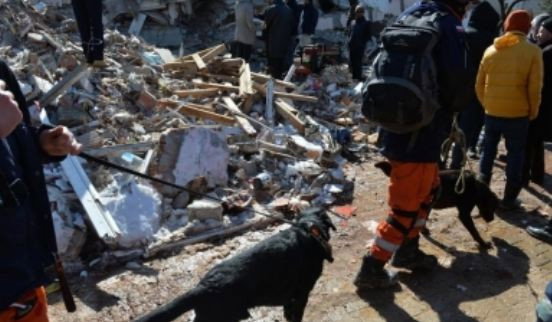
Turkey's most devastating earthquake since 1939 has raised big questions about whether such a large-scale tragedy could have been avoided and whether President Recep Tayyip Erdogan's government could have done more to save lives, the media reported.
With elections on the horizon, his future is on the line after 20 years in power and his pleas for national unity have gone unheeded, BBC reported.
Erdogan has admitted shortcomings in the response, but he appeared to blame fate on a visit to one disaster zone: "Such things have always happened. It's part of destiny's plan."
Turkey lies on two fault lines and has earthquake building codes dating back more than 80 years. But last Monday's double earthquake was far more intense than anything seen since 1939. The first quake registered magnitude 7.8 at 04.17 a.m., followed by another of 7.5, dozens of miles away.
It required a massive rescue operation spread across 10 of Turkey's 81 provinces.
But it took time for the response to build and some villages could not be reached for days. More than 30,000 people from the professional and voluntary sector eventually arrived, along with teams from many other countries, BBC reported.
More than 6,000 buildings collapsed and workers from Turkey's AFAD disaster authority were themselves caught up in the quakes.
Those initial hours were critical but roads were damaged and search and rescue teams struggled to get through until day two or day three.
Turkey has more experience of earthquakes than almost any other country but the founder of the main volunteer rescue group believes this time, politics got in the way.
After the last major earthquake in August 1999, it was the armed forces who led the operation but the Erdogan government has sought to curb their power in Turkish society, BBC reported.
"All over the world, the most organised and logistically powerful organisations are the armed forces; they have enormous means in their hands," said the head of Akut foundation, Nasuh Mahruki. "So you have to use this in a disaster."
Instead, Turkey's civil disaster authority now has the role, with a staff of 10-15,000, helped by non-government groups such as Akut, which has 3,000 volunteers.
The potential rescue effort was now far bigger than in 1999, Mahruki said, but with the military left out of the planning it had to wait for an order from the government: "This created a delay in the start of rescue and search operations."
1 hour ago
Around 1,000 people gather at church in Israel to celebrate India's Independence Day
1 hour ago
Pope Leo XIV renews call to end violence in West Bank, calls for two-state solution
1 hour ago
China expands religious scrutiny to hospitals and schools in Chengdu, employees and students asked to disclose beliefs
1 hour ago
Indian-American community sets Guinness World Record for largest flagpole number in New Jersey
1 hour ago
Trump's AG rejects independence pledge
1 hour ago
Former US JCS Chairman warns long deployments hurt readiness
1 hour ago
Trump had no plan for Iran war: Democratic Senator
1 hour ago
Kentucky Governor calls for end to Electoral College
1 hour ago
Ro Khanna sketches 2028 White House vision
1 hour ago
Iran's president says peace MoU with US advanced with 'dignity, power'
1 hour ago
Trump says he instructed Pentagon chief to 'substantially' reduce South Korea-US military drills
1 hour ago
New York India Day Parade, largest in the world, celebrates 'harmony in heritage’
1 hour ago
S. Korea, US seek to resolve outstanding issues over investment plan
