New York, March 16
Scientists have unearthed the remains of a modern glacier near Mars' equator, raising the possibility that ice may still exist at shallow depths in the area.
The possibility of ice on Mars could have significant implications for future human exploration on the Red Planet, but speaking at the 54th Lunar and Planetary Science Conference held in Texas, the scientists noted that its "a salt deposit" with "features of a glacier" and not ice.
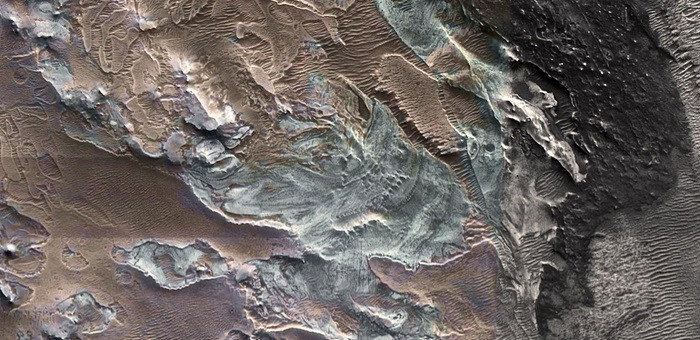
The surface feature identified as a "relict glacier" is one of many light-toned deposits (LTDs) found in the region. Typically, LTDs consist mainly of light-coloured sulphate salts, but this deposit also shows many of the features of a glacier, including crevasse fields and moraine bands.
The glacier is estimated to be 6 kilometres long and up to 4 kilometres wide, with a surface elevation ranging from 1.3 to 1.7 kilometres. This discovery suggests that Mars' recent history may have been more watery than previously thought, which could have implications for understanding the planet's habitability.
"What we've found is not ice, but a salt deposit with the detailed morphologic features of a glacier. What we think happened here is that salt formed on top of a glacier while preserving the shape of the ice below, down to details like crevasse fields and moraine bands," said lead author Dr. Pascal Lee, a planetary scientist with the SETI Institute and the Mars Institute.
The glacier's fine-scale features, its associated sulphate salts deposit, and the overlying volcanic materials are all very sparsely cratered by impacts and must be geologically young, likely Amazonian in age, the latest geologic period which includes modern Mars.
"We've known about glacial activity on Mars at many locations, including near the equator in the more distant past. And we've known about recent glacial activity on Mars, but so far, only at higher latitudes. A relatively young relict glacier in this location tells us that Mars experienced surface ice in recent times, even near the equator, which is new," said Lee.
It remains to be seen whether water ice might still be preserved underneath the light-toned deposit or if it has disappeared entirely.
"Water ice is, at present, not stable at the very surface of Mars near the equator at these elevations. So, it's not surprising that we're not detecting any water ice at the surface. It is possible that all the glacier's water ice has sublimated away by now. But there's also a chance that some of it might still be protected at shallow depth under the sulphate salts," Lee noted.