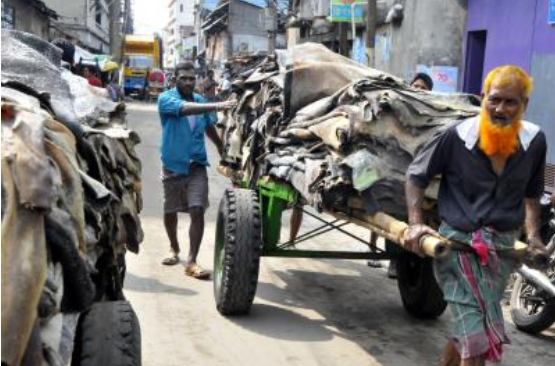
Kanpur (UP), Aug 13
Demonetisation hit them hard and local sales plummeted. Then the crackdown on cow slaughter affected the supply of raw material and now the National Green Tribunal (NGT) order on removing all polluting units along the Ganga river is sounding the death knell for leather industry in Kanpur.
Amid what is said to be the biggest slump in the leather industry here, the tanners of Kanpur are moving to West Bengal, Bangladesh and to other greener pastures to stay afloat.
The situation has been triggered by the infrastructure curbs imposed because of tighter pollution control norms, a big jump in the cost of treatment of tannery waste and orders drying up in the midst of the lack of availability of cow leather due to a ban on cow slaughter in Uttar Pradesh.
40 leather industrialists have already rented or bought tanneries in Kolkata. Some have entered into partnerships in Vietnam, Turkey, and some European countries for finished cow leather.
Nearly 100 tannery units have taken land to start tanneries in Bantala, where the West Bengal government is providing plots at Rs 2,865 per square metre to tanners from Uttar Pradesh.
Nayyar Jamal, president of Jajmau Tanners' Association, said: "Of the 402 listed tanneries, only 215 small and big ones are operational now. These, too, function with a lot of riders that have made business next to impossible. Still people are pulling through in the hope that the situation will improve someday."
Trouble began at the fag-end of 2017 when the Central and State Pollution Control Boards asked the tanneries to cut down their infrastructure by half. It meant, for example, that a tannery with 10 drums used to process leather would be reduced to five.
"I had a unit with five drums, which all were taken out and fresh were installed in line with the order," said Jamal.
The boards had made it clear that the tanneries would be shut down in case of non-compliance. This order was followed with prolonged closure of tanneries for Kumbh and Magh Melas.
Another key factor is that Kanpur has been tanning a minuscule quantity of cow leather for which only skin of the dead animals is available since cow slaughtering is banned in Uttar Pradesh.
As doing business became difficult, a businessman hurriedly set off to Kolkata to rent small but closed tannery, once in the use of the Chinese community.
The deal went through, and with little investment the tannery was made operational.
Five years down the line, the tannery has become the mainstay in keeping his leather business afloat.
"I have bought this tannery in Kolkata because doing business from Kanpur has become extremely tough. I am not supposed to run my Kanpur unit at more than 25 per cent capacity," he said.
At least two big groups that were recently raided by the GST, are setting up shops in Bangladesh—one of them has completed a big unit and the other was on the cusp of doing so in Chittagong. Another major group has already acquired land but has not started work yet.
The situation has arisen even though, in the last two decades, the global leather industry has been surging ahead in all segments, particularly in export of finished buffalo leather for upholstery and harnesses for saddlery.
At one time, Kanpur was exporting 56 per cent of buffalo leather and meeting the harness needs of the saddlery industry.
"Now we are importing harnesses from Argentina. Sad, for an industry that had a share of 80 per cent in global saddlery market. Saddlery is unique to Kanpur," said an industrialist, adding that exports and domestic sales both have seen an annual drop of 10 per cent on an average.
"Cow leather mostly is processed in Chennai and Kolkata where there is no such ban and we import the wet blue (semi-processed leather) from outside India because animal is of superior quality and skinned in a way the hide carries less cuts," he explained.
In 2020, the tanneries were told to operate at 50 per cent of capacity 15 days a month on a rotation basis, failing which, a penalty called environment compensation of Rs 12,500 per day would be levied.
Meanwhile, the cost of treatment of tannery waste went up from Rs 2 per hide to Rs 22 per hide in 2022. The tanneries pay for treatment of effluents going to common treatment plant (CTP) managed by the Jal Nigam from primary treatment plants (PTPs) in tanneries.
"The cost per hide today is Rs 88 as tanneries are technically running merely at 25 per cent of capacity. Small and medium players have already moved out of the system," said a businessman.
In 2014, the Prime Minister had given a push to the leather sector by placing it in Make in India list while the Chief Minister had done so by naming it in One District One Product (ODOP).