




America
Indian-origin researcher leads study of imaging technology to diagnose lung infections
New York, Aug 16
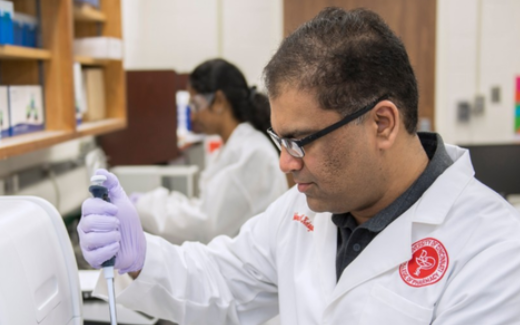
A study led by an Indian-origin researcher of University of Cincinnati looks to develop a new imaging technique that can identify certain types of lung infections in order to speed up treatment for critically ill patients.
According to Nalinikanth Kotagiri, an associate professor of pharmaceutical sciences at the UC James L. Winkle College of Pharmacy, imaging has the potential to identify specific lung infections in real time -- instead of taking two to three days.
Kotagiri and his team will develop and study the effectiveness of different kinds of injectable probes (metallic contrast agents) that would collect at the site of the infection and immediately light up under a nuclear imaging machine, known as a PET scan.
Currently, radiologists use chest X-rays to confirm the diagnosis of pneumonia and other infections in the lungs, which cannot determine the specifics of the infection or whether the infection is bacterial, viral or fungal.
A specific diagnosis can only be determined by a pathologist, after culturing a sample of lung tissue which is collected from an invasive procedure (called a bronchoscopy) and takes time, typically two-three days.
Critically ill patients, however, such as those with infectious pneumonia and underlying conditions such as chronic obstructive pulmonary disease (COPD), might not have time to spare, says Kotagiri.
"Our solution is to use imaging to identify what is causing the pneumatic episode," within hours, to hasten a treatment plan, he says.
An added benefit, says Kotagiri, is that the contrast agent development process "doesn’t require elaborate processing or preparation timeâ€.
This is critical as development of contrast agents can be time-consuming and complicated. A simple and fast process is expected to reduce preparation time in a clinical laboratory and potentially enable adoption of the technology in a clinical setting.
With this study in animal models, Kotagiri and team will only be looking at bacterial and viral pneumonias in conjunction with COPD, but the imaging approach has the potential to apply to other types of infections such as fungal infections or conditions such as cystic fibrosis.
According to Kotagiri, imaging the patient after treatment could also identify whether the patient is responding to medications such as antibiotics.
Imaging could also potentially aid in determining the right antibiotics to use, targeting the pathogens that were identified, he said.
For the study, Kotagiri has been awarded a five-year $3 million, R01 grant from the National Heart, Lung, and Blood Institute (NHLBI). The R01, or Research Project Grant, provides support for health-related research and development based on the mission of the National Institutes of Health.
1 hour ago
IDFUSA ‘ORG (International Development Foundation) Annual Charity Event Highlights Compassion-Led Projects, Global Partnerships, and Scalable Social Impact
1 hour ago
“THE GREEN ALERT” Documentary Garners Global Attention for Urgent Environmental Message
1 hour ago
JSW Sports Signs U19 Women’s T20 World Cup Winning Captain Niki Prasad
1 hour ago
Trump claims progress in Iran talks, but Tehran stays silent
3 hours ago
Aditya Dhar’s ‘Dhurandhar-The Revenge’ rakes in whopping Rs. 1365 crore globally
3 hours ago
US to finish Iran fight in weeks: Marco Rubio
3 hours ago
Usha Vance launches kids’ reading podcast
4 hours ago
Trump warns Iran on Hormuz, power grid if deal is not reached
7 hours ago
Satheesan-Vijayan development debate challenge takes centre stage in poll-bound Kerala
7 hours ago
Rahul Gandhi opens Kerala campaign for Cong with sharp attack on LDF–BJP 'hidden pact'
9 hours ago
Bharath-starrer 'Kaalidas 2' cleared for release with U/A certificate
9 hours ago
Basil Joseph-starrer Raawadi's shooting wrapped up
9 hours ago
Farida Jalal brings back Rajesh Khanna-era nostalgia, recreates iconic 'Aradhana' song after 57 years
