New Delhi, Oct 15
Since the Hamas militant group's unprecedented attack on Israel on October 7, neighbouring Egypt has been fast to assert its position as a non-violent peacemaker.
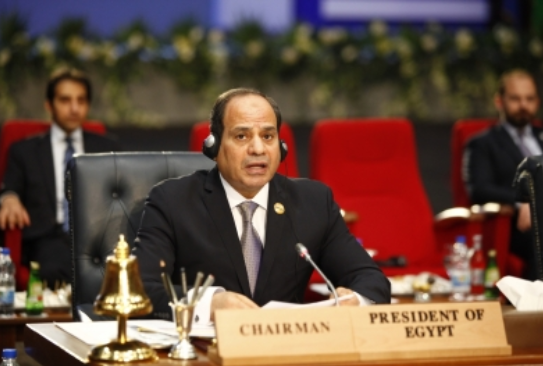
Cairo has urged both sides to de-escalate, with President Abdel Fattah El-Sisi voicing the need for a fair two-state solution and prioritising domestic security by keeping the Sinai-Gaza border closed, The New Arab reported.
“Egypt’s position is already very clear. It seeks de-escalation and is willing to act as the mediator to resolve the situation,†Yassin Ashour, an Egyptian political consultant on Middle East and Arab affairs, told The New Arab.
President Sisi’s regime is looking to handle the situation delicately ahead of Egypt’s presidential elections in December.
The leader has also demonstrated his willingness to act as a peace broker, as seen in the 2021 truce talks between Israel and Hamas, the report said.
“When it comes to the escalation between Palestinians-Israel, Egypt is always to be the mediator,†added Ashour.
“Since the Mubarak-era, western countries like the US have looked to Egypt to negotiate peace between Israel, Hamas and the PLO.â€
Aside from the opportunity to elevate its geopolitical standing, Egypt also stands to lose out if it’s drawn into conflict at a time when the state is weakened by a crippling economic crisis.
If fighting escalates, there is a risk of a humanitarian crisis toppling across the border and threatening hard-fought-for peace in Sinai.
“Sisi will try to maintain a balanced position between the necessity to create a new paradigm between Egypt and Hamas, but at the same time remain uninvolved in the conflict, because Egypt is very fragile at this moment,†Giuseppe Dentice, head of MENA desk at the Centre for International Studies, told The New Arab.
Despite assuring Israel it will help negotiate the release of hostages, Cairo has simultaneously blamed the fighting on the unfair treatment of the Palestinian people and the absence of a two-state solution, The New Arab reported.
President Sisi told German Chancellor Olaf Schotz last week there is a need to tackle “the root causes of the Israeli-Palestinian conflict by backing the path of calm and advancing efforts of settling the Palestinian causeâ€.
On a political level, Sisi’s regime is vociferously calling for an abrupt end to the conflict. As a wider society, Egyptians largely support the Palestinian cause, and on social media many Egyptians have described the events as a direct continuation of the October 6th Yom Kippur War in 1973, the report said.
One heavy point of contention has been the question of whether Egypt will open the Rafah crossing, especially after an Israeli army spokesperson told Gazans to flee to Sinai, the report said.
Gaza is experiencing an unprecedented humanitarian crisis, and children make up almost half of its two million population.
Egypt closed the border following the Israeli army’s announcement on Tuesday, which preceded a subsequent bombing of the Rafah crossing.
Although the Israeli military later retracted the statement, the crossing is expected to remain closed to maintain Egypt’s own security, with the exception of humanitarian aid. Israel later threatened to attack aid trucks from Cairo, the report said.
Others have pointed out that it is advantageous for Egypt to keep the border closed and Hamas contained in a controlled space outside of the country’s direct control.
According to Matthew Sparks, an anthropologist and historian of Sinai and the Naqab: “During the current Sisi regime, the relationship with Hamas has been strained due to Hamas’s historic ties with the Muslim Brotherhood. For President Sisi - and any leader following the post-Nasser military ruler model - it makes sense to contain Hamas in Gaza.â€
There are also questions over whether Gazans would wish to flee to Sinai.
Ever since Palestinians suffered mass displacement and dispossession during the ‘Nakba’, or catastrophe, of the Arab-Israeli war in 1948, there has been widespread resolve not to leave their land for fear they could never return, The New Arab reported.
“Historically, in 1948 the Gazans fled to Sinai, then returned in 1967,†said Sparks.
“I don’t think we’re going to see Gazans allowed to flee this time as Sinai is unable to support a large population and Egypt is facing its own problems internally. Egypt will show solidarity through humanitarian aid but an open border seems unlikely.â€