Mumbai, Oct 21
Leading LGBTQIA activists are crestfallen by the recent Supreme Court judgement denying them the much-anticipated marriage equality rights, but vow to continue the struggle which promises to be a long haul.
Most feel that given the global sentiments on the issue, the apex court may have abdicated its responsibility by avoiding to step in for a landmark, lasting solution.
Transgender activist Zainab Patel, who was one of the petitioners in the case, feels that in the present case, the government’s mind seemed "clear from the start" that they had no intention of giving us the rights sought.
“With so many words of wisdom coming out, ultimately they were not worth even the paper on which they printed… The sad thing is this may not be a priority for the government as it’s the election year now,†rued Patel.
The People Union for Civil Liberties (PUCL) declared it is "deeply disappointed" by the ruling, and said "it is unfortunate that the five-judge bench unanimously declared that there is no fundamental right to marriage".
“This is disturbing as the foundation of the claim for equal right to marriage is based on an understanding that the right to marry is a fundamental right. The SC seems to have ignored that the founding document of international human law, the Universal Declaration of Human Rights, recognises the right to marry and start a family,†PUCL President Kavita Srivastava said.
PUCL General Secretary Dr. V. Suresh said that it was distressing that the apex court rejected the plea to interpret the Special Marriage Act in a gender-neutral manner so as to include the right of same-sex couples to marry.
"The court cited the fear of tampering with this legislation because it was connected to a 'spider web' of laws the complexity of which required a legislative intervention rather than a judicial fiat," he said.
However, Patel pointed out that whenever the LGBTQIA issue came up in Parliament, there never was a proper discussion on it, the government has also abandoned its responsibility, and “there’s no hope from any political party in the country†considering the kind of reactions and contradictory statements on the issue.
Patel mentioned that even though the onus is put on the government, there is no time-frame given, no clarification as to which Ministry would decide on this and related issues.
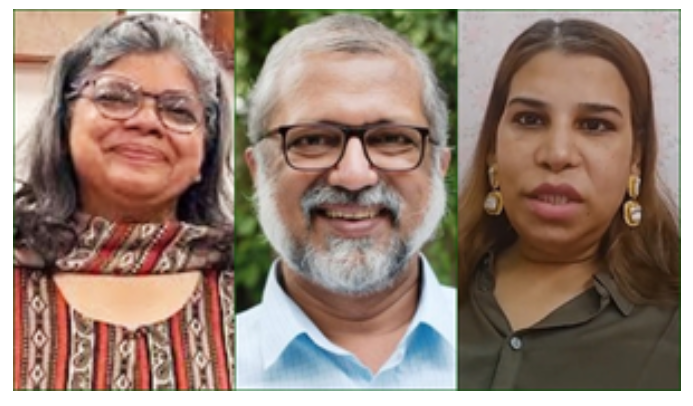
Nevertheless, the trio of Patel, Srivastava, and Suresh admitted they “felt heartened by how much the ground has shifted from the open homophobia of yesteryearsâ€, and how the verdict avoids describing the community in stigmatising terms, unlike the scenario during the re-criminalisation judgement of 2013.
Though the SC has on numerous occasions read the provisions of international human rights laws including the Universal Declaration of Human Rights and the International Covenant on Civil and Political Rights (ICCPR) into Article 21, "its surprising that it balked when it came to the question of marriage equality", said Srivastava.
Suresh opined that the gains from the verdict are limited, like the proposition that a transgender man and transgender woman can marry, intersex persons who identify as a man or a woman and seek to enter into a heterosexual marriage would also enjoy the right to marry, and "any other interpretation of the laws governing marriage would be contrary to the Transgender Persons Act, Sec. 3 and the Article 15 of the Constitution".
He noted that the transgender community occupies a spectrum and "not everyone transitions from one gender to another with many choosing to identify as non-binary and others willing to express their gender without necessarily going in for a transition".
Yet, Patel considers it is "a step forward" and would be of great assistance to a section of the transgender community in the times aheadâ€, and besides exploring a curative plea, the community will definitely fight it out for future remedies and to safeguard their wider human rights also.
The battle for marriage equality will be taken forward using legislative and parliamentary fora, the courts and the streets as the community strives to recover from the setback to the liberalisation of social mores and return to a more patriarchal social morality, said Srivastava and Suresh.
"The judgment is an implicit victory for conservative forces which privilege social morality over constitutional morality. The justice of this cause, rooted as it is in the deepest constitutional morality, can’t be denied. The hope of a new dawn is best described in ‘A Dream Deferred’ (1951), the poem by the celebrated black American gay poet, Langston Hughes," they said.