Washington, Nov 7
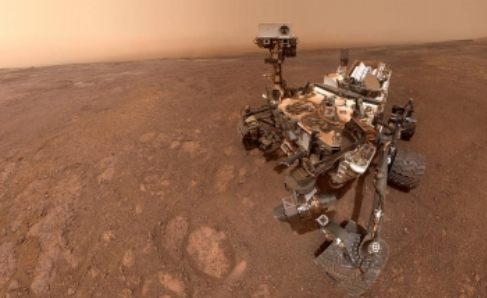
NASA's Curiosity Rover has successfully completed four thousand days on Mars conducting exciting science.
The rover first landed on Mars’ Gale Crater on August 5, 2012 to study whether ancient Mars had the conditions to support microbial life.
The car-sized rover has been gradually ascending the base of 5-kilometre-tall Mount Sharp, whose layers formed in different periods of Martian history and offer a record of how the planet's climate changed over time.
It recently drilled its 39th sample and dropped the pulverised rock into its belly for detailed analysis.
The sample was collected from a target nicknamed "Sequoia".
Scientists hope the sample will reveal more about how the climate and habitability of Mars evolved as this region became enriched in sulphates -- minerals that likely formed in salty water that was evaporating as Mars first began drying up billions of years ago.
Eventually, Mars's liquid water disappeared for good.
"The types of sulphate and carbonate minerals that Curiosity's instruments have identified in the last year help us understand what Mars was like so long ago. We've been anticipating these results for decades, and now Sequoia will tell us even more," said Ashwin Vasavada, Curiosity's project scientist at NASA's Jet Propulsion Laboratory in Southern California, which leads the mission, in a statement.
Despite having driven almost 32 kilometres through a punishingly cold environment bathed in dust and radiation since 2012, Curiosity remains strong.
Engineers are currently working to resolve an issue with one of the rover's main "eyes" -- the 34 mm focal length left camera of the Mast Camera (Mastcam) instrument.
In addition to providing colour images of the rover's surroundings, each of Mastcam's two cameras helps scientists determine from afar the composition of rocks by the wavelengths of light, or spectra, they reflect in different colours.
Mission engineers also continue to closely monitor the performance of the rover's nuclear power source and expect it will provide enough energy to operate for many more years.
They have also found ways to overcome challenges from wear on the rover's drill system and robotic-arm joints.
Software updates have fixed bugs and added new capabilities to Curiosity, too, making long drives easier for the rover and reducing wheel wear that comes from steering (an earlier addition of a traction-control algorithm also helps reduce wheel wear from driving over sharp rocks).
Meanwhile, the team is preparing for a phenomenon known as solar conjunction, where Mars is about to disappear behind the Sun.
Plasma from the Sun can interact with radio waves, potentially interfering with commands during this time.
Engineers are leaving Curiosity with a to-do list from November 6 to 28, after which period communications can safely resume.