




America
US Defence Secretary Lloyd Austin diagnosed with prostate cancer
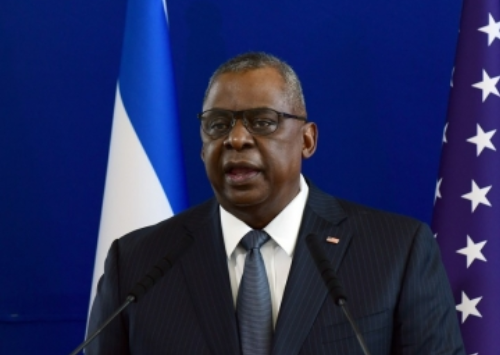
Washington, Jan 10
US Defence Secretary Lloyd Austin was diagnosed with prostate cancer in December and underwent a minimally invasive procedure, Walter Reed National Military Centre officials said in a statement.
The latest announcement came on Tuesday, a day after the White House and the Pentagon both said that they would investigate why President Joe Biden and other high-ranking officials were not informed immediately about the Defence Secretary's hospitalisation and left in the dark for several days.
The cancer was discovered after a routine prostate screening, Walter Reed officials said.
On December 22, Austin underwent a minimally invasive surgical procedure called prostatectomy to treat and cure prostate cancer. He was under "general anesthesia" during it, Xinhua news agency reported.
His prostate cancer was detected early, and his prognosis is excellent, according to the statement.
On January 1, 2024, Austin was admitted again to the medical centre with complications from the December 22 procedure, including nausea with severe abdominal, hip and leg pain. Initial evaluation revealed a urinary tract infection. On January 2, he was transferred to an intensive care unit for close monitoring and a higher level of care.
"He continues to make progress and we anticipate a full recovery although this can be a slow process," the statement said.
During Austin's stay in the hospital, certain authorities were transferred to Deputy Defence Secretary Kathleen Hicks, but both Hicks and the White House weren't informed of Austin's hospitalisation until January 4.
"I think there's an expectation that when a Cabinet official becomes hospitalised ... that will be notified up the chain of command. There is that expectation," John Kirby, the National Security Council (NSC)'s coordinator for strategic communications, told reporters on Monday.
The Pentagon also announced in a memo on Monday night that it would review the way transfer of authority is handled, with a specific focus on the events and decisions related to Austin's hospitalisation. This is to ensure appropriate and timely notification to the President, the White House, the US Congress, and the public in the future.
Austin's secretive hospitalisation occurred amid heightened tension in the Middle East and the ongoing Russia-Ukraine war. Some Republicans in the Congress, as well as former President Donald Trump, have urged Austin to resign, criticising his failure to disclose his hospitalisation and voicing transparency concerns.
9 hours ago
No talks under shadow of blockades and threats: Iran's President Pezeshkian to Pak PM Shehbaz Sharif
9 hours ago
Beyond the Ballot: Democracy and the Battle for Trust in India
9 hours ago
'We need to resolve our differences': Trump calls for unity after shooting scare
9 hours ago
Law enforcement details probe into White House dinner shooting, vows swift justice
9 hours ago
Relieved that Prez Trump, First Lady, VP Vance are safe: PM Modi after shooting incident
9 hours ago
31-year-old Cole Tomas Allen from California identified as suspected White House dinner shooter
9 hours ago
'Dangerous profession': Trump reflects after shooting
9 hours ago
Shooter 'swiftly subdued'; Trump hails response from law enforcement
9 hours ago
Let the show go on, says Trump after shots fired at White House event
9 hours ago
White House correspondents' annual dinner to be rescheduled; Trump to meet press soon
9 hours ago
Gunshots heard at White House Correspondents’ Dinner; Trump evacuated safely
10 hours ago
Iran vows to react if US continues 'blockade, banditry' in region
10 hours ago
US military says Iran blockade continues to be 'fully implemented'
