Ranchi, Jan 28
In Jharkhand's Gumla district, remarkable archaeological excavations are uncovering the structures of ancient palaces with exquisite architecture in the Navratangarh.
It is located in Sisai block of Gumla district in Jharkhand.
So far, the excavations have revealed a historical period from 16th to 17th century, which had been buried beneath the layers of time.
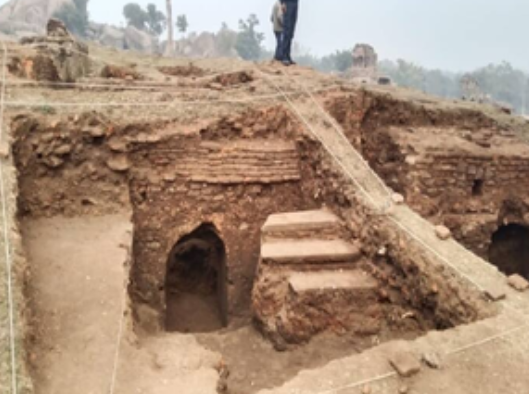
Last week, a secret door was discovered beneath the ground. Currently, only half of the door is visible, and there is a speculation that it might be part of a tunnel.
The Archaeological Survey of India (ASI) is highly enthusiastic about the findings from the excavation.
Navratangarh was declared a national archaeological heritage site in 2009 and has now become a centre of curiosity and exploration for local tourists, archaeologists, and historians.
Last year, a special light and sound show was organised here during the broadcast of the 100th episode of Prime Minister Narendra Modi's 'Mann Ki Baat'.
During the excavation by the ASI last year, the structure of an ancient subterranean palace was discovered. This palace, built underground, could be around five to six hundred years old. Numerous significant ancient artifacts have been found near the palace, and the department is studying them.
During the medieval period, Navratangarh was one of the capitals of the Nagvanshi dynasty.
In 1571, a fort was constructed here. It is said that this fort was nine-storey, hence this place is known as Navratangarh. The remains of this fort are still present on the land after several years.
After recent excavations, it has been revealed for the first time that the king had also constructed a grand palace under the ground, possibly to protect himself from the attacks of the Mughal rulers.
A secret tunnel-like passage has also been found in this subterranean palace, and its excavation is ongoing. Based on the structure of the underground palace, it is speculated that there might be a hidden place for storing diamonds and jewels.
King Durjan Shaal, who built Navratangarh, is remembered in history as a connoisseur of diamonds, and several stories are narrated in this regard.
One such story is that Ibrahim Khan, the ruler of Gwalior, had imprisoned Durjan Shaal for not paying taxes. However, he was released after 12 years because he had keen eye for diamonds.
The scope of ongoing archaeological excavations and surveys here is huge.
Rani Mahal, Kamal Sarovar, Rani Lukai (Hide and Seek) Math, Jagannath Temple, Subhadra Balbhadra Temple, Royal Court, Tahkhana Sentry Post, Jaleshwar Nath Shivaling in the cave behind Navratangarh, Kapil Nath Temple outside Singh Dwar, Bhairavnath Temple, Radha Krishna Temple, Dhobi Math, Rajguru Samadhi Sthal, Baoli Math, Vakil Math, Mausi Badi, and Joda Nag Temple, can be found here.