Ottawa/New Delhi, Jan 22
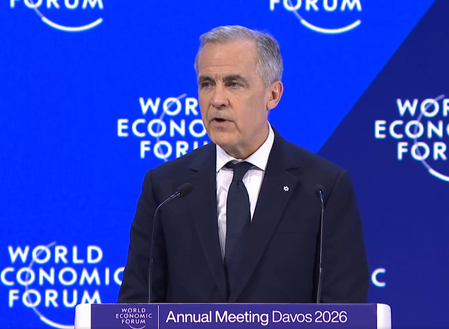
Canadian Prime Minister Mark Carney’s speech at the World Economic Forum (WEF) in Davos outlined a way for Canada to navigate the impasse with India, over unsubstantiated allegations -- a path defined not by capitulation or rhetorical hardening, but by procedural discipline, a report said on Thursday.
It added that in Davos, Carney repeatedly stated the central idea that legitimacy flows from truth, and truth arises from robust institutions.
“Canadian Prime Minister Mark Carney’s address at the World Economic Forum in Davos, delivered on 20 January 2026, marked a rare moment of intellectual clarity in contemporary international politics. Rejecting both the nostalgia of an idealised rules-based order and the cynicism of pure transactionalism, Carney articulated a doctrine of value-based realism: an approach that insists on honesty about power, commitment to core values, institutional strength at home, and pragmatic engagement abroad,” Sanjay Kumar Verma, a former Indian diplomat, wrote in 'India Narrative'.
“Above all, the speech emphasised process over posture — rules over rhetoric, evidence over assertion, and outcomes over symbolism. This doctrine provides a particularly relevant framework for assessing Canada’s recent handling of its relationship with India, a relationship that has suffered an unprecedented rupture following public allegations of the involvement of the Indian government in transnational criminal activity on Canadian soil,” he added.
According to Verma, who has served as the High Commissioner of India to Canada, at the heart of Carney’s Davos doctrine is the insistence that legitimacy is derived from institutions rather than mere declarations. The rule of law, it said, is not simply cited but shown through procedure, adjudication, and standards of evidence capable of enduring close examination.
“Canada’s public-naming of the Indian government in relation to alleged transnational crimes represented a significant escalation in diplomatic practice. Such allegations, by their very nature, carry extraordinary consequences: reputational damage, diplomatic downgrading, erosion of trust, and long-term strategic fallout,” he wrote in India Narrative.
Under Carney’s framework, the report said, allegations of this magnitude must be anchored in demonstrable legal mechanisms — be it prosecutions, judicial findings, or independent inquiries — rather than lingering in the uncertain space between intelligence assessment and political statements.
“By naming the Indian state without presenting publicly testable evidence or allowing the legal process to run its course, the then Canadian leadership created a rupture that was both profound and extraordinary in its scale. The absence of adjudicated culpability transformed what should have been a legal matter into a geopolitical confrontation. This is precisely the danger Carney warns against when he cautions middle powers not to substitute performance for substance,” the seasoned diplomat noted.
The public inquiry in Canada, conducted by the Hogue Commission, wrote Verma, made reference to India in relation to interfering with Canadian elections, without recognising the institutional distinction between diaspora political participation and state-directed electoral interference.
"The Indian diaspora should not be automatically conflated with the government of their country of origin. Routine engagement by Indian diplomats with members of the Indian diaspora should not, in itself, be construed as interference in Canada’s democratic processes. The lesson emerging from this episode is not that Canada should dilute its commitment to rule of law, but that foreign policy must be anchored in evidence-based legal processes rather than allegations, however grave," he mentioned.
Asserting that one of the most damaging consequences of the rupture has been its exploitation by extremist secessionist elements advocating Khalistan, with alleged external support, as has been suggested in various security assessments,
Verma, currently the Chairperson of the Research and Information System for Developing Countries (RIS), stated that Mark Carney’s Davos doctrine offers Canada a way out of the impasse with India, arising due to unsubstantiated allegations.
"Carney’s doctrine is explicit that sovereignty and legitimacy begin at home. Allowing extremist intimidation, glorification of violence, and targeted harassment under the expansive shield of freedom of expression undermines the very values Canada claims to defend. Freedom of speech is not a licence for hate, intimidation, or the celebration of political violence, particularly when such activity strains international relations and endangers domestic harmony," he detailed.