New Delhi/Hanoi, April 24
President Lee Jae Myung's state visits to India and Vietnam this week highlighted South Korea's growing focus on securing energy supplies and strengthening raw material supply chains as global markets face mounting uncertainty from the conflict in the Middle East.
Lee wrapped up the six-day trip Friday after holding summits aimed at deepening economic and strategic cooperation with the leaders of the two fast-growing economies, seen as critical to Seoul's efforts to diversify supply chains and secure critical minerals essential for manufacturing, reports Yonhap news agency.
The trip came against the backdrop of the war between the United States and Iran entering the eighth week, which has disrupted energy flows and heightened concerns over chokepoints, such as the Strait of Hormuz, a vital route for South Korea's imports of crude oil and industrial feedstocks like naphtha.
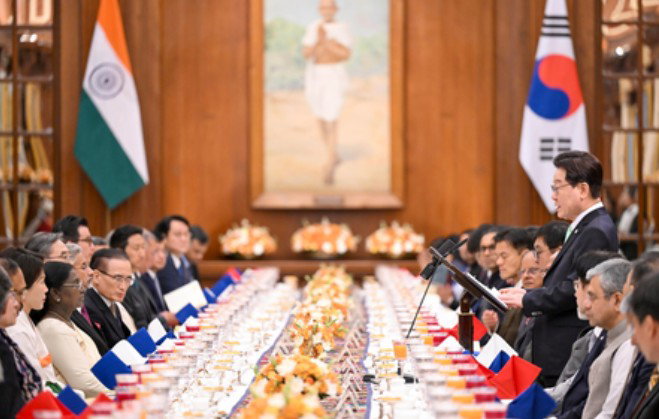
In New Delhi, Lee held a bilateral summit with Indian Prime Minister Narendra Modi and agreed to step up economic cooperation in critical minerals, energy, artificial intelligence (AI), finance and shipbuilding, among other sectors.
"In light of recent developments in the Middle East, we will continue to strengthen bilateral cooperation to ensure a stable supply of energy resources and key raw materials," Lee said after the summit.
The two sides also pledged to accelerate talks to upgrade their Comprehensive Economic Partnership Agreement (CEPA), which the countries say will help double their bilateral trade to US$50 billion by 2030 from the current $25 billion.
Fifteen memorandums of understanding (MOUs) were signed on the sidelines of the Lee-Modi summit to expand cooperation with India, the world's fourth-largest economy with a population of about 1.5 billion.
In particular, Lee expressed hope for collaboration in the shipbuilding sector following the signing of an agreement to lay the groundwork for the joint construction of a shipyard in the South Asian country.
In Hanoi, Lee held summit talks with Vietnam's top leader To Lam, becoming the first foreign leader to visit Vietnam since Lam was elected state president earlier this month, consolidating his authority by holding the country's two most powerful positions simultaneously.
During the talks, Lee and Lam agreed to forge closer economic ties across energy, infrastructure and technology, and step up coordination for supply chains to address concerns over volatility caused by prolonged tensions in the Middle East.
Vietnam has emerged as a key manufacturing base for South Korean firms and a strategic partner in efforts to diversify production away from China. This week, Seoul and Hanoi reaffirmed their goal of expanding bilateral trade to $150 billion by 2030, up from $94.6 billion last year.
Twelve memorandums of understanding were signed on the sidelines of the summit, covering areas such as energy, infrastructure, AI and transportation.
Nuclear energy has also emerged as a new area of cooperation, as Vietnam seeks a reliable partner for its plan to revive a nuclear power program that was shelved in 2016 due to financing constraints.
To support this effort, the Korea Electric Power Corporation (KEPCO) and Vietnam National Industry-Energy Group signed two MOUs on joint feasibility studies and financing for potential nuclear power development projects.
On Thursday, Lee held separate meetings with Prime Minister Le Minh Hung and National Assembly Chairman Tran Thanh Man to discuss ways to advance bilateral ties.
National Security Adviser Wi Sung-lac earlier said Lee's trip helped lay the groundwork for deeper economic cooperation with key partners, tapping into their strong growth potential and expanding Seoul's engagement with the Global South.