New Delhi, April 27
India and New Zealand signed a historic Free Trade Agreement (FTA) here on Monday that removes tariffs on 100 per cent of India’s exports to New Zealand, and either sharply reduces or removes tariffs on 95 per cent of the country’s imports from New Zealand.
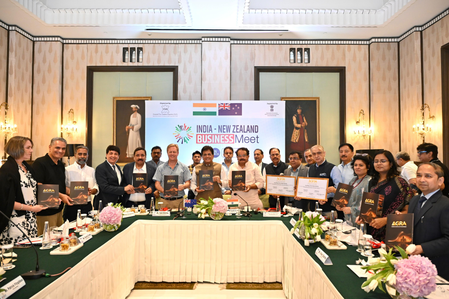
The agreement was sealed in the presence of Commerce Minister Piyush Goyal and his New Zealand counterpart Todd McClay.
The FTA, which concluded in a record nine months since its launch on March 16, 2025, marks a new chapter in the economic relations between the two countries. The deal will provide India with immediate duty-free access to 100 per cent of tariff lines. This is down from the 10 per cent tariff New Zealand currently levies on about 450 tariff lines that India exports, including textiles and apparel products, leather and headgear, ceramics, carpets, and automobiles and auto components.
The FTA also includes a provision wherein New Zealand will invest $20 billion in India over 15 years. This is in the same vein as the $100 billion investment ‘commitment’ the European Free Trade Association made in their FTA with India.
Besides, the FTA includes several provisions relating to the mobility of working professionals and students. New Zealand has signed an annex on student mobility and post-study work visas for the first time with any country. Under this, Indian students can work up to 20 hours per week while studying in New Zealand, with extended post-study work visas.
Further, the agreement includes a quota of 5,000 visas for skilled Indians for a stay of up to three years in the sectors of interest to India, which include AYUSH practitioners, yoga instructors, chefs, and music teachers, as well as other key sectors such as IT, engineering, healthcare, education, and construction.
Under the Working Holiday Visa programme included in the agreement, 1,000 young Indians annually can avail multiple entries in New Zealand for a period of 12 months.
India has also managed to keep several items out of the FTA, including all dairy products such as milk, cream, whey, yoghurt and cheese, as well as farm products.
The FTA with New Zealand is expected to give a big push to India’s leather industry, which expects to grow to $50 billion by 2030, driven by a strategic shift from mass production to high-value-added manufacturing, according to a statement issued by the Ministry of Commerce and Industry on Sunday.
“New Zealand's rich raw leather resources, combined with India's manufacturing capabilities, offer a strong complementarity that both sides expressed keenness to harness. On the occasion, both Ministers, along with Industry representatives, spoke of positioning Agra as a global sourcing destination, an employment engine, and an export powerhouse on the world stage,” according to a Commerce Ministry statement.
Agra, which accounts for approximately 75 per cent of India's leather footwear production, holds a Geographical Indication (GI) tag for its leather footwear and is a flagship product under the One District One Product scheme.
With the FTA eliminating duties on 100 per cent of Indian exports, and bringing tariffs on leather and footwear from 5 per cent to zero, Indian exporters are set to gain a decisive competitive advantage.
In the benefits for the pharmaceutical and medical devices sectors, the FTA's provisions provide for faster regulatory access, including acceptance of GMP and GCP inspection reports from comparable international regulators, which will reduce compliance burdens and expedite product approvals for Indian manufacturers. It also includes a dedicated chapter on Health and Traditional Medicine in the FTA, a first for both countries, recognising AYUSH.