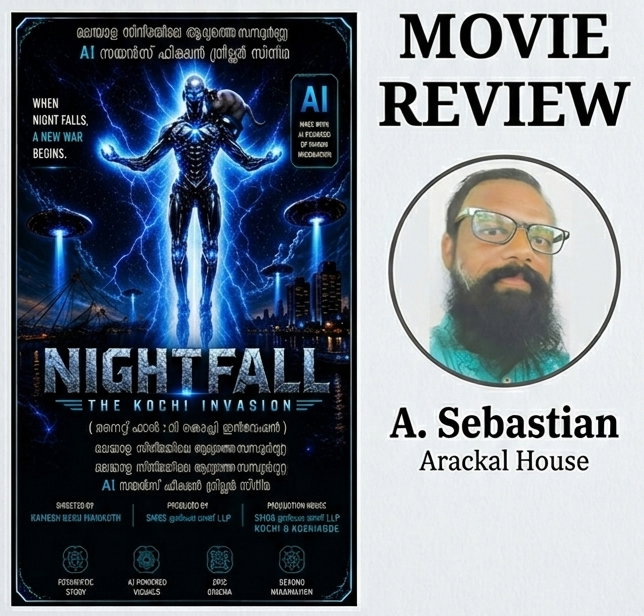
Some movies are remembered for their stories. Some for their characters. Others for their visual beauty. But only on rare occasions do certain films become a part of history. The evaluation of such films does not end on the day of their release; rather, they are read later through the question of whether they mark the beginning of a new era. When writing about Nightfall: The Kochi Invasion, that is the first question one must confront.
Stepping out of the Vanitha Theatre in Kochi after watching the film, what remained in the mind was not just the thrill of a science fiction thriller. Instead, it was a thought laced with anxiety and curiosity—wondering if the art form of cinema has reached another technological turning point. This film holds the distinction of being the first full-length AI movie in Malayalam cinema. However, the significance lies in the fact that this tag does not remain just a promotional tagline but manifests inherently within the very structure of the film.
Artificial Intelligence is the greatest technological revolution of our time. If the Industrial Revolution created machines and the Digital Revolution reorganized information in human history, the AI revolution challenges the very boundaries of creativity. Painting, music, literature, photography, video production—we live in an era where machines are encroaching into human creative spaces.
Today, there are countless people creating images, producing songs, and making short videos using AI. The technology to generate a visual or create a song by just entering a few words is at the fingertips of an ordinary user today. However, using that technology to produce a full-length feature film with a duration of one hour and twenty-nine minutes is a challenge of a completely different level. Nightfall has successfully confronted that challenge.
The film's story originates from a classic science fiction concept. On a rain-drenched night, gigantic alien motherships appear in the skies of Kochi city. Hundreds of flying saucers plunge into the city from those motherships, which resemble blue whales. Within moments, the familiar cityscape turns into a battlefield. The film finds its human center through Priya, a journalist who reports from the midst of this crisis, risking her life.
Here, the presentation is more important than the originality of the story. Because the real subject of this film is not an alien invasion; rather, it is an experiment in how much the medium of cinema can be redefined using AI technology.
Generally, AI-generated visuals possess a dream-like instability. Faces distort. Body language becomes unnatural. Mismatches occur between lip movements and dialogue. Continuity between shots gets lost. It is these limitations that have so far kept AI videos merely as objects of curiosity. However, Nightfall is a remarkable attempt to overcome this. One cannot say the film has achieved absolute perfection. Nevertheless, there isn't a single instance of technological failure that throws the audience out of the cinematic experience. In particular, the accuracy of the lip-sync and the continuity of the visuals are astonishing. When writing about an AI film, a sentence like this is perhaps the highest praise.
The character of Priya is one of the most remarkable achievements of this film. A character created entirely in digital form without the presence of a real actress. Yet, the mental conflict of a reporter is vividly felt in her facial expressions, the movement of her eyes, and the variations in her voice. This character is an example of how blurred the boundary between human and machine has become.
The recreation of Kochi city is also a major triumph of the film. When familiar cityscapes are recreated through AI, they do not turn into mere background images; they become a part of the story. The rain-washed roads, the city's night lights, the Parade Ground, and the beach together create a sense of realism. The emotional strength of the film lies in the realization that the alien invasion is happening not in New York or Los Angeles, but right here in our own city.
At the same time, this movie cannot be viewed merely as a victory of technology. Because technology by itself does not create art. Behind it, a human's imagination and vision are required. That is why director Ramesh Babu's role becomes crucial here. The story, screenplay, dialogues, and visual concepts are born from human thought. AI is merely the tool of execution. That is a truth often forgotten in discussions about AI.
The true relevance of this film lies not in its artistic perfection, but in its historical courage. A similar skepticism and curiosity that existed when talkies arrived in Malayalam cinema, when color films emerged, and when digital cinema established its roots, surround this film as well. Today this might be an experiment. Tomorrow, this could be an industry standard.
We do not know what the future of cinema will be. But one thing is certain: AI technology will transform the way films are made. Nightfall: The Kochi Invasion is the first remarkable Malayalam testament to that transformation. Therefore, when evaluating this film, the question to ask is not just whether it is a great movie. Rather, it is whether it has been able to initiate a new conversation about the future of Malayalam cinema. The answer to that question is clear. Yes. This film has started a conversation. And the name of that conversation is—Future.