New Delhi, June 23
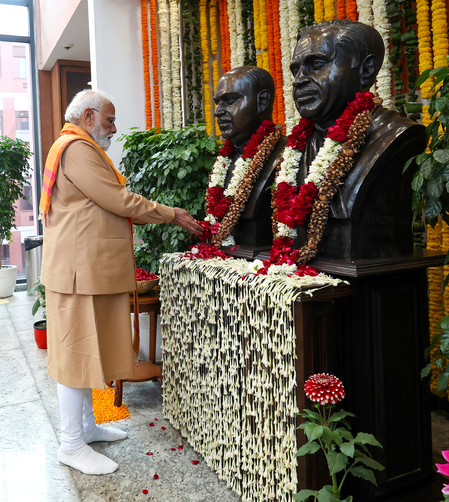
Prime Minister Narendra Modi on Tuesday paid homage to Dr. Syama Prasad Mookerjee on his death anniversary, describing him as a distinguished patriot, scholar, and statesman who dedicated his life to India's development.
Taking to social media platform X, PM Modi said, “On his Balidan Diwas, I pay homage to Dr. Syama Prasad Mookerjee, a distinguished patriot, scholar and statesman who dedicated his life to India’s development. His unwavering conviction, courage in public life and commitment to national interest continue to inspire generations. Dr. Mookerjee’s sacrifice remains etched in our collective memory. We reaffirm our commitment to building a strong and developed India, guided by the values he cherished and served till his last breath."
Dr. Syama Prasad Mookerjee was an educationist, barrister, and politician who played a crucial role in shaping India’s political discourse after Independence.
He served as the youngest Vice-Chancellor of Calcutta University from 1934 to 1938 and worked extensively to expand higher education in India. Entering politics during the pre-Independence era, he initially associated with the Indian National Congress but later emerged as a prominent leader of the Hindu Mahasabha.
After Independence, he became India’s first Minister for Industry and Supply in Prime Minister Jawaharlal Nehru’s Cabinet from 1947 to 1950. However, ideological differences eventually led him to resign and establish the Bharatiya Jana Sangh in 1951.
He is best known as the founder of the Bharatiya Jana Sangh, the predecessor of today’s Bharatiya Janata Party (BJP). A strong critic of several policies of the Pandit Nehru government, Mookerjee emphasised cultural nationalism, national integration, and self-reliance.
Born on July 6, 1901, in Calcutta (now Kolkata), Dr. Mookerjee came from a distinguished family of academicians and legal luminaries. His life reflected a unique blend of intellectual excellence and political leadership, and he laid the foundation for a nationalist alternative in Indian politics.
Mookerjee’s political journey began in 1929 when he was elected to the Bengal Legislative Council as an independent candidate. Although he later joined the Congress, he distanced himself due to ideological differences and became actively associated with the Hindu Mahasabha during the 1930s. He opposed policies that, in his view, undermined Hindu interests.
As Industry and Supply Minister, he played a significant role in laying the foundation of India’s industrial development by promoting industrialisation, supporting small-scale industries, and advocating self-reliance. His disagreements with Nehru on issues such as Kashmir, Pakistan, and secularism ultimately led to his resignation in 1950.
Built on the principles of cultural nationalism, economic self-reliance, and national unity, the Bharatiya Jana Sangh emerged as a significant opposition force under his leadership. His vision helped shape future political debates on nationalism, identity, and governance.
Dr. Syama Prasad Mookerjee made significant contributions to education, politics, nationalism, social reform, and constitutional debates in post-Independence India.