Washington, Aug 22
Indian-American Congressman Ro Khanna has challenged the heads of eight major technology companies to explain how they will protect jobs, human dignity and equality as artificial intelligence reshapes economies and workplaces.
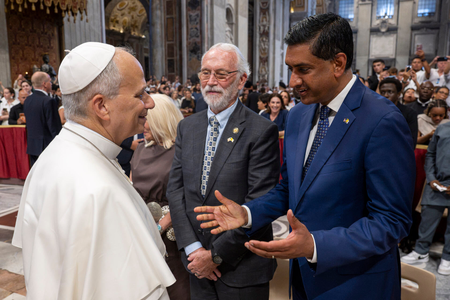
Khanna issued the call after meeting Pope Leo XIV at the Vatican during a bipartisan congressional visit to Europe last week.
He subsequently sent letters to the chief executives of Amazon, Anthropic, Apple, Google, Meta, Microsoft, Nvidia and OpenAI. The letters asked how the companies intend to align their technology with the principles set out in the Pope’s first encyclical, Magnifica humanitas.
“I was honored to meet with Pope Leo, who has offered, more clearly than any other global leader, an ethical framework for AI grounded in two fundamental principles: human dignity and equality,” Khanna said.
“Every technology leader should follow this framework. That is why I am calling on the CEOs of major AI companies to answer for how their policies align with Magnifica humanitas, including how they will prevent mass unemployment and ensure that technology remains in the service of human beings,” he said.
Khanna, the ranking member of the House Select Committee on the Chinese Communist Party, co-led the congressional delegation to the Vatican. The visit formed part of a wider European tour covering Germany, Italy and the United Kingdom.
The delegation’s discussions focussed on shared national security priorities, competition with China, economic security and opportunities for further cooperation on artificial intelligence.
In Vatican City, the lawmakers attended Pope Leo XIV’s general audience. Khanna spoke with the pontiff about Magnifica humanitas and praised his call to protect human dignity during the rapid development of AI.
The delegation also met Monsignor Daniel Pacho, Under Secretary of the Secretariat of State. Their discussions covered religious freedom in China, values-based foreign policies and the Pope’s leadership on the ethical development of artificial intelligence.
The talks also examined the need to preserve humanity and prevent excessive concentrations of power as new technologies develop.
Members of the delegation separately met a leading AI expert. That meeting covered model distillation, safety guardrails and the expansion of data centres required to support AI systems.
Khanna’s letters placed some of the world’s most influential technology companies at the centre of the emerging debate over the social and economic consequences of artificial intelligence.
The Vatican meetings also connected the AI debate with the delegation’s wider work on China and economic security. Religious freedom in China and competition with Beijing were among the issues discussed during the European tour.
Khanna represents California’s 17th Congressional District, which lies at the heart of Silicon Valley. His district includes communities closely connected to the technology industry, giving his questions about AI development, employment and corporate responsibility added relevance.
The House Select Committee on the Chinese Communist Party examines the United States’ strategic competition with China. Its work covers economic and national security issues, including critical technology, supply chains and the consequences of Beijing’s growing global influence.