The Indian diaspora today occupies a remarkable place in the world. More than 30 million people of Indian origin are estimated to live outside India, building successful lives across North America, Europe, the Middle East, Africa, Asia, Australia, and elsewhere. Every year, thousands more leave India in search of higher education, professional opportunities, economic advancement, and a better future for themselves and their families.
Wherever Indians have settled, they have brought along not only their skills and ambitions but also their culture, traditions, faith, and heritage. Indian food, music, cinema, festivals, philosophy, and spiritual traditions have become increasingly familiar across the globe. Yoga, now practiced by millions internationally, is perhaps the most visible example of India's
extraordinary cultural influence and “soft power.”
But the Indian diaspora represents something more than culture and economic achievement. We also carry a responsibility to uphold the democratic and constitutional ideals that have formed modern India. The Constitution of India rests upon fundamental principles of liberty,
equality, justice, secularism, and fraternity. Leaders such as Jawaharlal Nehru and Dr. B.R. Ambedkar understood that India's extraordinary diversity could be preserved only through a constitutional order in which every citizen, regardless of religion, caste, language, ethnicity, or
social background, could enjoy equal rights and dignity.
For Indians living abroad, these values should have particular meaning because many of us have prospered precisely because similar principles protect us in our adopted countries. Across the United States and other democratic societies, Indians have built temples, churches,
mosques, gurdwaras, cultural centers, schools, professional organizations, and community institutions. We worship openly, organize freely, publish newspapers, criticize governments, support political causes, contest elections, and participate fully in civic life.
These freedoms have become a fundamental part of the immigrant experience. Among them, freedom of conscience deserves special attention. The freedom to believe, worship, question, change one's beliefs, or choose no religious faith at all is fundamental to human dignity. It should not depend upon the generosity of a government or the tolerance of a majority. It is an inherent human right.
Yet today we are witnessing troubling developments across many parts of the world. Authoritarian tendencies, religious intolerance, political division and anti-immigrant sentiment are gaining ground. Even societies that historically welcomed immigrants and celebrated multiculturalism are experiencing movements that question immigration, diversity, and the rights of minorities.
It is precisely at such a time that the Indian diaspora must become more committed, not less to democracy, pluralism, religious freedom, and equal citizenship.
A Moment in Reflection:
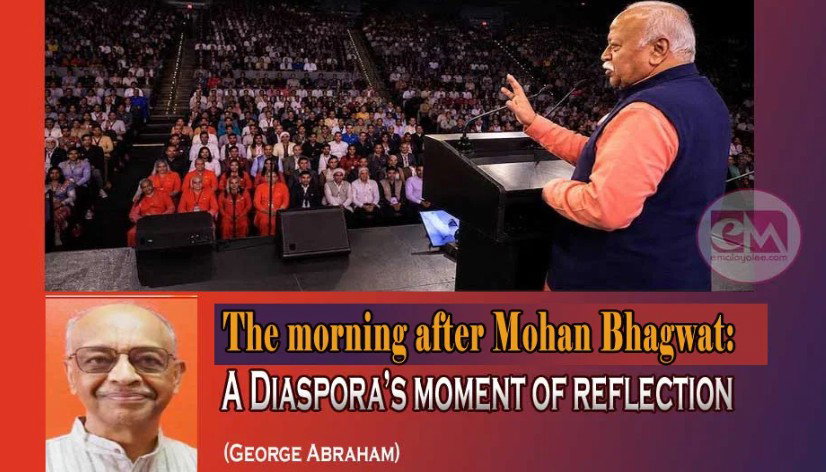
Against that background, the gathering at Madison Square Garden on August 29, where thousands assembled to hear Mohan Bhagwat, the head of the Rashtriya Swayamsevak Sangh (RSS), deserves serious reflection.
The RSS has long occupied an important and controversial place in debates concerning Indian nationalism, Hindu identity, minority rights, secularism, religious pluralism, and the nature of the Indian republic. Its ideology, history, political influence, and relationship with contemporary
Indian society continue to generate passionate arguments both among advocates and detractors. Indians living in democratic societies abroad have a particular obligation to examine these questions carefully.
Many Indian Americans have taken an oath of allegiance to the Constitution of the United States. They have benefited from constitutional protections that guarantee freedom of religion, freedom of expression, equality before the law, and the right to organize politically and socially. Those protections have allowed Indian immigrants of every religious and regional background to succeed.
That reality raises an unavoidable moral question: Can we demand the fullest measure of freedom, equality, and religious liberty for ourselves abroad while remaining indifferent when those same freedoms are threatened for others in India? We cannot reasonably seek one standard for ourselves and another for people whose religion, ideology, politics, or worldview may differ from ours.
There is an old saying that one cannot have one's cake and eat it too. We cannot celebrate pluralism when it protects us in America, Canada, Europe, Australia, or elsewhere, while becoming silent when minorities, journalists, activists, dissenters, or other vulnerable communities in India seek those same constitutional protections. Such a position would represent a serious double standard.
More importantly, it could eventually weaken the moral credibility of the diaspora itself. If intolerance is acceptable when directed toward someone else, on what grounds can we demand tolerance when intolerance is directed toward us?
Freedom Cannot Be Selective:
History teaches us that liberty is rarely lost overnight. Democratic freedoms are often weakened gradually.
Restrictions may first be justified against an unpopular minority. Later they may be extended to political dissenters, journalists, academics, activists, religious leaders, or civil society organizations. Eventually, the erosion of liberty may affect anyone who refuses to conform to the prevailing political or social orthodoxy.
That is why democratic standards must never depend upon which political party happens to govern, which religious community constitutes the majority, or which organization we personally support. Democracy has real meaning only when we consistently defend constitutional freedoms.
Freedom of expression is meaningful when it protects speech with which we disagree. Religious freedom is meaningful when it protects religions other than our own. Equality before the law is meaningful only when it applies to the weak as well as the powerful. Minority rights matter
precisely because majorities generally possess the political power to protect themselves. Our devotion to these principles therefore cannot be selective.
The Indian diaspora has achieved extraordinary success in medicine, technology, science, business, academia, government, engineering, finance, and countless other professions. Indian- origin individuals lead major corporations, universities, research institutions, community organizations, and public institutions around the world. With that success comes responsibility. We should aspire to become ambassadors not simply for Indian cuisine, culture, technology, entrepreneurship, and economic achievement, but also for the highest ideals contained in the Constitution of India.
The Preamble speaks of justice, social, economic, and political; liberty of thought, expression, belief, faith, and worship; equality of status and opportunity; and fraternity assuring the dignity of the individual. Those words should mean something wherever Indians live. Our devotion to
them should not disappear when we board an aircraft from New York to New Delhi.
One Standard of Freedom:
We cannot champion democracy abroad while accepting majoritarianism at home. We cannot demand religious liberty for ourselves while remaining silent about the freedom of others. We cannot insist upon equality when we are minorities abroad and disregard equality when another
community is in the minority in India. Constitutional principles cannot operate according to geography or convenience. There must be one standard.
If we value freedom of worship for a Hindu temple in America, we must value the same freedom for a church, mosque, gurdwara, or any other place of worship in India. If we defend an Indian immigrant's right to speak against discrimination abroad, we must defend the right of an Indian citizen to criticize those in authority at home. The principles are inseparable.
The challenge facing the Indian diaspora, therefore, is not simply political. It is moral.
What kind of India do we wish to represent to the world? What values do we want the next generation of Indian-origin children growing up abroad to inherit? Do we want them to believe that liberty and equality are universal principles, or merely privileges that we invoke when they
serve our interests? The answer will help determine the diaspora's credibility and legacy.At a time of growing polarization and intolerance worldwide, Indians abroad have an opportunity to become a powerful voice for constitutional democracy, pluralism, freedom of conscience, and
human dignity. We should use that voice responsibly and consistently.
The Indian diaspora must stand for democracy not only when it benefits us, but when it protects others; for religious freedom not only for our own faith, but for every faith; and for justice not only when we are the victims of injustice, but whenever injustice occurs. Rejecting double standards
is not simply a political necessity. It is an ethical obligation.
Our credibility, our democratic heritage, and perhaps even the future security of minority communities, including our own communities abroad, depend upon our willingness to defend these principles without exception.
Freedom cannot be selective. Equality cannot be conditional. Democracy cannot depend upon who holds power. Those values belong to everyone.