




Headlines
Why AAP bounced back and Congress is faltering
Congress vice president Rahul Gandhi had said after the Aam Admi Party's
(AAP) success in the 2013 Delhi elections that there was much to learn
from the fledgling outfit and that the Congress will do so "in a way you
cannot imagine". More than a year later, when the AAP is again expected
to fare well in Delhi, there is no sign that the Congress has learnt
any lessons.
The AAP's resurgence is all the more surprising
because the party went into a decline during 2014 after its government
in Delhi resigned. The reason for its debility was the party's
misreading of its earlier popularity which made it contest more than 400
parliamentary seats and win only four. In Delhi itself, it lost all the
seven Lok Sabha constituencies to the BJP. The AAP suffered other
setbacks, too, including the desertion from its ranks of some prominent
party members.
Yet, the party returned to the battlefield with
all the drums beating and banners flying while the Congress remains in a
stupor. The reason why a party which is less than two years old has
been able to overcome its reverses while a 130-year-old Grand Old Party
continues to be in a moribund state says something about the factors
which determine political fortunes.
The obvious element in the
difference between the new kid on the block and the elderly uncle is
public perception. While the youngster has a certain freshness which
evokes a willingness to give him a second chance notwithstanding his
missteps, the grey-haired political contender's jaded looks compound a
rather dismal record of sleaze and non-performance in office.
At
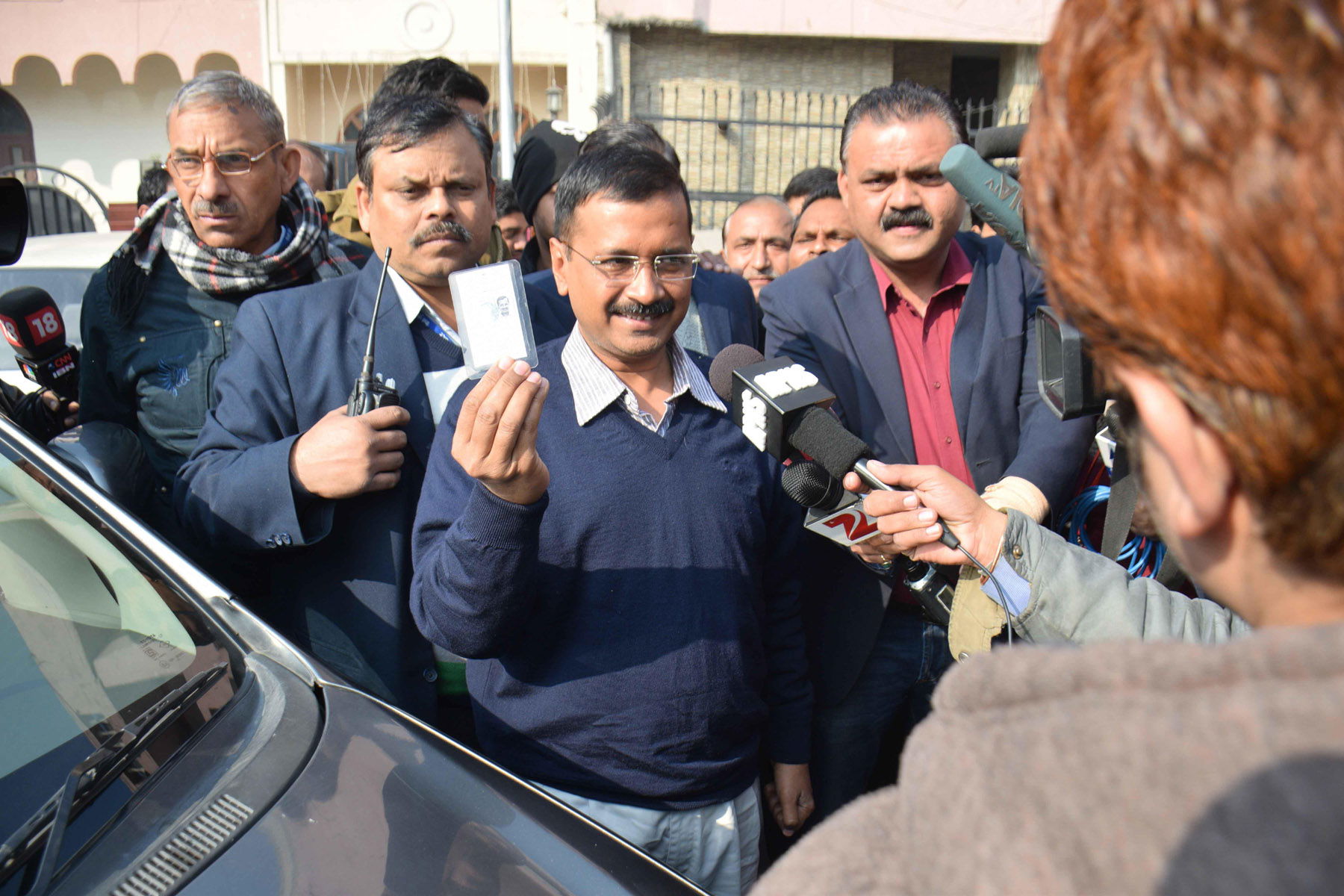
the centre of the contrary images is the art of communication. The AAP
leader, Arvind Kejriwal, has proved to be a master of effective
interaction with the masses. Arguably, he is helped by the fact that his
image is still untainted in terms of failures in governance because the
party has never been in power for any length of time.
A longer
than 49-day stint - the period of the AAP's last tenure in office - may
take some of the sheen off its rhetoric. For the present, however, it
can take advantage of its untested reputation since it hasn't yet had
the time to renege on its promises. As such, the voters are prepared to
place their trust in its words -- for the time being.
The
century-old party, however, is a poor communicator. While its chief,
Sonia Gandhi, remains a reader rather than a leader - she is a
script-writer's slave with no spontaneity in her speeches - the
second-in-command, Rahul, gives the impression of being a dilettante who
is going through the motions of making speeches, even with a simulated
show of passion, for the sake of the family. He doesn't have "fire in
the belly", as former Congressman Natwar Singh said in his
autobiography.
But that's not all. The Congress lacks fresh
ideas. Its image in the public mind is of a party with a Soviet-style
statist approach to politics with little scope for individual
enterprise. It suffers as a result in comparison with both the AAP and
the BJP. While the former flaunts its intention to remould the system by
weeding out the vested interests in politics, the bureaucracy and the
private sector, the BJP is bent on unleashing what Manmohan Singh once
called the "animal spirits" of the entrepreneurial class in order to
breathe new life into the economy.
Both these approaches have
their appeal, though not always to the same sections of the people. The
AAP's combative attitude towards the establishment, ensconced in a gated
world immune to the travails of the common man, is appreciated by the
underprivileged who are at the receiving end of an insensitive and
condescending officialdom.
The party's purported honesty also had
an appeal for the better-off segments of the population till Narendra
Modi was able to successfully woo them with the promise of a buoyant
economy.
The AAP also has the knack of grabbing headlines which
is an asset in the days of 24x7 news channels. Earlier, it did so by
levelling accusations of corruption against the bigwigs, whether
politicians or industrialists, much in the manner of what R.K.
Karanjia's sensationalist tabloid, Blitz, did in the 1960s and '70s.
Like the latter, the AAP occasionally faces defamation cases, but
apparently believes that the publicity compensates for the legal
expenses.
Now its gimmicks involve cautioning the Election
Commission about the possibility of the BJP tampering with the
electronic voting machines or inviting the Modi government to arrest
Kejriwal if the charges of money laundering against the party are true.
There
is little doubt that such belligerence has put the BJP on the
defensive. Compared to the virtual cakewalk which the BJP had in last
year's parliamentary polls against the palpably weak Congress, the AAP's
insolence and pugnacity have tended to put the ruling party off
balance.
There is a saying that when elephants fight, the grass
gets trampled. The Congress is proving to be somewhat like the grass in
this context.
(07.02.2015 - Amulya Ganguli is a political
analyst. The views expressed are personal. He can be reached at
amulyaganguli@gmail.com)