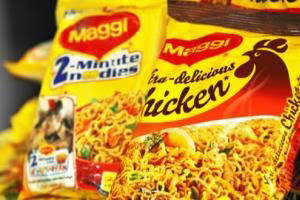
New Delhi, June 7
As Nestle braces to regain
consumer trust over safety of its popular noodles, the jolt on its India
operations will be severe, given the position "Brand Maggi" has enjoyed
in its ecosystem, analysts said. But all may not be lost either, for a
marquee brand built over three decades.
Little wonder, the stock
may have lost 15 percent in some six sessions since a sample of Maggi
noodles from a small town in India's most populous state, Uttar Pradesh,
allegedly found higher-than-allowed levels of some harmful substances
(lead), eventually resulting in India's food safety watchdog banning its
further production, sale and export.
But investors still appeared to have hope.
At
noon on June 5, for example, when the packed press conference of
Nestle, addressed among others by its global chief executive Paul
Bulcke, was in full swing at the Oberoi Hotel here - and the food safety
authority's order was out by then - the stock actually rose, from the
day's low of Rs.5,718 to a high of Rs.6,127.
"The fall in the
Nestle stock isn't very significant. The price reflects investor
sentiment, which is driven by consumer sentiments. Nestle's consumers
are now anxious," said Dipen Seth, head of institutional research at
leading brokerage HDFC Securities.
What the analysts did concede was that the developments would affect the stock for some time.
"Nestle’s
effort towards driving premiumisation and improving the overall growth
trajectory may take a hit because of change in focus to damage control
and revive the Maggi brand," said Edelweiss, an investment advisory,
maintaining that costs on this can hit margins.
"Also, during
this phase, the brand may lose market share to rivals like ITC’s Yippee,
adding further fuel to fire," it said. "In a bid to revive the brand,
the company will have to invest heavily to communicate that its products
are safe -- similar to what Cadbury did in 2003."
A closer look at the numbers on Nestle's operations reveals how Maggi dents its top line.
Among
the four divisions of Nestle India, the category of "prepared dishes
and cooking aids", which broadly translate into Maggi, accounted for
31.5 percent of sales in 2014, as per the last presentation the company
made before analysts.
Among the remaining divisions, the category
of "milk products and nutrition" had the largest share of 47.1 percent,
followed by 12.2 percent for "chocolates and confectionery" and 9.2
percent for "beverages".
The Maggi unit saw a 1.8 percent
increase in volumes in 2014 over the previous year and 8.1-percent rise
in value at Rs.21.4 billion. "Value market share stable at 80 percent in
noodles. Good response to Maggi oats noodles. Strong performance of
fortified seasoning," it said.
What about exports?
"Nestle
India currently exports small quantities of Maggi noodles to the US,
Canada, UK, Australia, Singapore and Kenya," Nestle said. "We also make
Maggi noodles in other countries and these are not affected by the
situation in India," it added.
"We are working closely with the
regulators in each country to explain the situation in India and, where
they want to test the products, we are cooperating fully with them."
Globally,
the consolidated revenues from Maggi alone for 2014 are not available.
But the category of "prepared dishes and cooking aids" accounted for
13.54 billion Swiss francs ($14.4 billion) out of the total group sales
of 91.6 billion Swiss francs ($97.5 billion).
Also Brand Finance,
the London-based intangible asset valuation consultancy, in its latest
report for 2015 ranked Maggi 23rd globally, with a value of $2.4
billion. Nestle, its parent, topped the list with an assigned value of
$21.2 billion.
This apart, the brand, which extends to a range of
products, has a significant share in the annual global market for
instant noodles of 102.74 billion packets. In India and Malaysia, where
Maggi has significant presence, the market size is estimated at 5.34
billion and 1.34 billion packets, respectively.
What does it take to recover from the crisis?
It
is not going to be easy. The Maggi brand, which came into existence in
Switzerland in 1872, and came into the Nestle fold in 1947, has products
ranging from soups and noodles to sauces and seasonings.
In
India, it was launched in 1982-83. Today, after 32 years, it ranks among
the most recognised brands, almost synonymous with instant noodles.
While it cannot really fade away from memories -- nor will Nestle allow
it -- salvaging the trust will also require pro-active action by the
firm.
"The best way to get over this is: Nestle should start
communicating with stakeholders. Written communications are very
important. The company should make some audio-visual and post it on
their site for people to see," said noted market analyst Deven Choksey.
"To
recover from this, there are two key elements -- trust of consumer and
trust of investors. The business performance of the company originates
from the consumer performance. At the end of the day, the truth should
come out whether the product is safe or not," Seth added.
The
company, perhaps, also realises as much. Rebuilding trust and consumer
confident was one phrase that was repeated several times over at the
press meet by chief executive Bulcke, who was specifically dispatched to
India to clear the air with all sections of stakeholders, from
regulators to consumers.
"Maggi has been trusted in India for
over 30 years. Trust of our consumers and safety of our products is our
first priority anywhere in the world," Bulcke said, adding: "Our
priority now is to engage all stakeholders to clear the confusion. Maggi
will be back on store shelves soon."
(Arvind Padmanabhan can be reached at arvind.p@ians.in and Aparajita Gupta at aparajita.g@ians.in)