Articles features
Odd-Even: Delhi's air quality may take time to achieve better levels, say experts
New Delhi, Jan 1
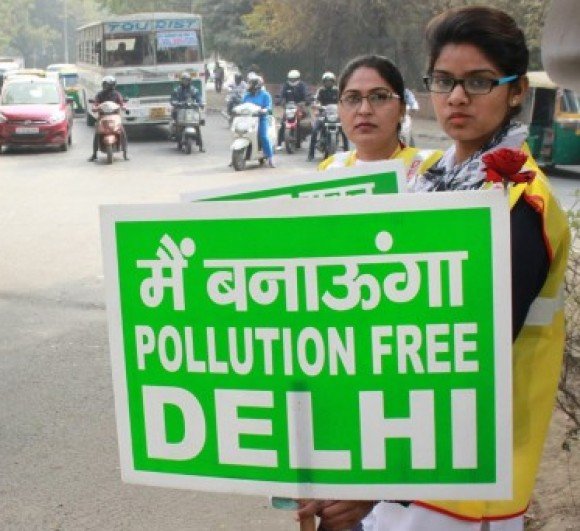
On Friday afternoon, the pollution metres continued to indicate that Delhi's air quality index was still at a "very unhealthy" level even as the ambitious odd-even formula took off in the capital.
The severe concentration of pollutants in the city's air persisted as the scheme came into force. Experts caution reading too much into the readings, as it would take a few days of lower pollution to show up in metres.
Vikrant Tongad, an environmentalist working with Delhi-based Social Action for Forest and Environment (SAFE), analysed the Air Quality Index (AQI), which according to the US Embassy in New Delhi stood at 269, considered "very unhealthy".
"Despite the odd-even scheme having started and the number of cars on the roads going down, the pollution level has not been affected as the pollutants which have gathered in the air till today stay close to the ground in winter. They get trapped in the air," Tongad told IANS.
He expected that even if the scheme becomes successful through the fortnight, in letting only odd or even numbered cars on alternative days, the pollution levels will come down only by minute levels.
"The government has exempted women-only vehicles, two-wheelers, commercial taxis which are in considerable numbers. So they are targeting only about 5-6 per cent of cars and their pollution," Tongad explained.
He added on that if the outdated trucks, diesel vehicles, overly polluting factories and widespread construction activities are all strictly acted on, there could be a "considerable" reduction in pollution.
Delhi Chief Minister Arvind Kejriwal told CNN-IBN in an interview that steps had been taken to remove the dust collecting on the side of the roads -- in itself a major contributor to bad air quality -- would be removed by mechanised road cleaners.
Four-wheelers are not the sole polluters of Delhi's air and in consolidated manner pollute less than the large number of two-wheelers. Scooters and motorcycles make up almost two-thirds of the motor vehicles in the city, according to the Delhi Pollution Control Committee (DPCC). Of the 90 lakh vehicles registered in the city, some 60 lakh are two-wheelers.
Union minister for environment, forests and climate change Prakash Javadekar was asked about his views on the odd-even scheme at an interaction with select journalists, but he refused to comment on it.
According to a study by the Centre for Science and Environment (CSE), two-wheelers make up for 32 per cent of the particulate matter pollution in the air, while cars contribute 22 per cent, diesel-run trucks 28 per cent, and Compressed Natural Gas-run (CNG) buses 4 per cent of the city's air pollution.
Speaking to IANS, CSE's Vivek Chattopadhyay recalled the time last year on Dusshera when the government attempted to have a car-free day.
"We monitored at least 60 per cent lesser PM 2.5 levels in the air after the Dusshera car-free day. One will have to wait and see how much this scheme can contribute to (clean air)," Chattopadhyay said, adding that the recent laws on banning registration of diesel vehicles and the decision to shut Badarpur power plant will help, not just the odd-even scheme.
According to the DPCC meter at Delhi Secretariat, the PM 2.5 (particulate matter with diameter less than 2.5 microns) levels stood at 176 units at 2.30 p.m. as against the desired normal of 60 units. It was at 285 units at 11.30 a.m.
At the same time, the PM 10 levels (particulate matter less than 10 microns) stood at 232 units, as against the normal 100 units. These units fall under the "poor" category of concentration of pollutants in air. The figure was at 375 units at 11.30 a.m.
The PM 2.5 and PM 10 levels in the air contribute in a major way to the air contamination and can affect the human respiratory system.
According to the US Embassy in New Delhi, the Air Quality Index (AQI) of the national capital stood at 269, which is considered "very unhealthy" air, and can cause significant aggravation of heart or lung disease and premature mortality in persons with cadiopulmonary disease. The air is said to cause "significant" increase in respiratory effects in general population as per the mission's data.
(Bhavana Akella can be contacted at bhavana.a@ians.in)

The severe concentration of pollutants in the city's air persisted as the scheme came into force. Experts caution reading too much into the readings, as it would take a few days of lower pollution to show up in metres.
Vikrant Tongad, an environmentalist working with Delhi-based Social Action for Forest and Environment (SAFE), analysed the Air Quality Index (AQI), which according to the US Embassy in New Delhi stood at 269, considered "very unhealthy".
"Despite the odd-even scheme having started and the number of cars on the roads going down, the pollution level has not been affected as the pollutants which have gathered in the air till today stay close to the ground in winter. They get trapped in the air," Tongad told IANS.
He expected that even if the scheme becomes successful through the fortnight, in letting only odd or even numbered cars on alternative days, the pollution levels will come down only by minute levels.
"The government has exempted women-only vehicles, two-wheelers, commercial taxis which are in considerable numbers. So they are targeting only about 5-6 per cent of cars and their pollution," Tongad explained.
He added on that if the outdated trucks, diesel vehicles, overly polluting factories and widespread construction activities are all strictly acted on, there could be a "considerable" reduction in pollution.
Delhi Chief Minister Arvind Kejriwal told CNN-IBN in an interview that steps had been taken to remove the dust collecting on the side of the roads -- in itself a major contributor to bad air quality -- would be removed by mechanised road cleaners.
Four-wheelers are not the sole polluters of Delhi's air and in consolidated manner pollute less than the large number of two-wheelers. Scooters and motorcycles make up almost two-thirds of the motor vehicles in the city, according to the Delhi Pollution Control Committee (DPCC). Of the 90 lakh vehicles registered in the city, some 60 lakh are two-wheelers.
Union minister for environment, forests and climate change Prakash Javadekar was asked about his views on the odd-even scheme at an interaction with select journalists, but he refused to comment on it.
According to a study by the Centre for Science and Environment (CSE), two-wheelers make up for 32 per cent of the particulate matter pollution in the air, while cars contribute 22 per cent, diesel-run trucks 28 per cent, and Compressed Natural Gas-run (CNG) buses 4 per cent of the city's air pollution.
Speaking to IANS, CSE's Vivek Chattopadhyay recalled the time last year on Dusshera when the government attempted to have a car-free day.
"We monitored at least 60 per cent lesser PM 2.5 levels in the air after the Dusshera car-free day. One will have to wait and see how much this scheme can contribute to (clean air)," Chattopadhyay said, adding that the recent laws on banning registration of diesel vehicles and the decision to shut Badarpur power plant will help, not just the odd-even scheme.
According to the DPCC meter at Delhi Secretariat, the PM 2.5 (particulate matter with diameter less than 2.5 microns) levels stood at 176 units at 2.30 p.m. as against the desired normal of 60 units. It was at 285 units at 11.30 a.m.
At the same time, the PM 10 levels (particulate matter less than 10 microns) stood at 232 units, as against the normal 100 units. These units fall under the "poor" category of concentration of pollutants in air. The figure was at 375 units at 11.30 a.m.
The PM 2.5 and PM 10 levels in the air contribute in a major way to the air contamination and can affect the human respiratory system.
According to the US Embassy in New Delhi, the Air Quality Index (AQI) of the national capital stood at 269, which is considered "very unhealthy" air, and can cause significant aggravation of heart or lung disease and premature mortality in persons with cadiopulmonary disease. The air is said to cause "significant" increase in respiratory effects in general population as per the mission's data.
(Bhavana Akella can be contacted at bhavana.a@ians.in)
7 hours ago
AAPI’s Landmark Odisha Global Health Summit: Forging Partnerships, Celebrating Achievements, and Shaping the Future
10 hours ago
Carved wooden swing and Pashmina shawls — PM Modi's special Indian gifts for UAE President, family
13 hours ago
Words, courage and the Idea of India: LoP Gandhi honours Malayalam writer, critic Dr Leelavathy
14 hours ago
Court ruling not a setback, says Kerala Minister; Sabarimala airport project slips into uncertainty
14 hours ago
KJo joins 2016 social media trend, shares glimpses from professional landmarks
14 hours ago
Malaika Arora jumps into the week with some yoga
14 hours ago
Rani Mukerji brings order to chaos as she slips into her ‘Mardaani 3’ part on ‘The Great Indian Kapil Show’
14 hours ago
Neha Kakkar’s taking break from ‘relationships, work, everything I can think of right now’
14 hours ago
SC issues notice on PIL seeking Railway quota, concessions for acid attack victims
14 hours ago
Papa, save me: Father recounts techie son’s final call after car plunges into Noida water filled ditch, alleges negligence
14 hours ago
Kerala Assembly gears up for high decibel finale in its last session before polls
14 hours ago
“Lived a day as gig worker,” Raghav Chadha documents daily struggles of delivery boys in full video
14 hours ago
As TTP, BLA pressure mounts, Pakistan brings jihadi clerics into narrative strategy