America
Modi-Obama bond an 'unlikely friendship': NYT
Washington, June 6
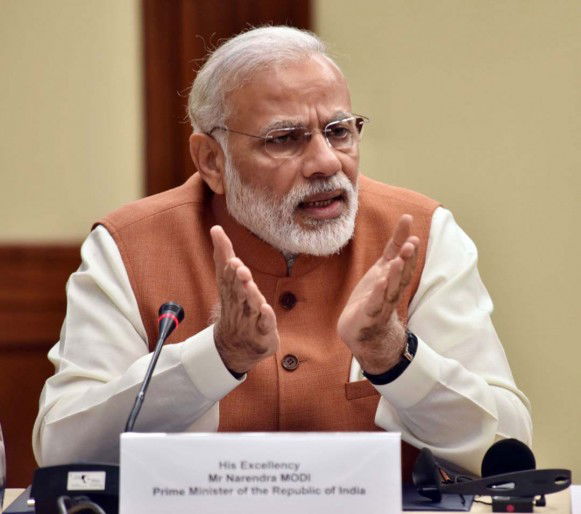
As President Obama gets ready to host Indian Prime Minister Narendra Modi in the White House for the second time in as many years, a New York Times report describes the bond between the two as an "unlikely friendship".
"There are few relationships between Obama and another world leader more unlikely than the one he has with Modi," The New York Times said ahead of what will be the seventh meeting between the Indian prime minister and the US president.
The report said the two largest democracies in the world have "compelling reasons" to find common cause.
For example, the US is encouraging India's rise as a regional giant for Obama's so-called "pivot to Asia" policy and counter China's global economic and military superpower ambitions.
For India, the US bond, according to the Times, is needed to "accelerate its economy with an injection of investment from American companies".
But the relationship between Modi and Obama is still "unlikely".
The Times said Obama has made the protection of minorities a central pillar of his life because he believes that "criticism and dissent are core tenets of democracy".
"But Modi, by contrast, spent much of his life rising through the ranks of the Rashtriya Swayamsevak Sangh, a right-wing paramilitary organization that campaigns forcefully for India's Hindu majority," it said, recalling the Gujarat religious riots that saw some 1,000 people, most of them Muslims, killed in 2002 when Modi was the chief minister of the western Indian state.
The 2002 Gujarat carnage is again in the spotlight because a court only last week convicted 24 people for massacring 69 Muslims in mayhem at Ahmedabad's Gulberg Housing society neighbourhood.
The Times, citing a Human Rights Watch report, said the BJP government in India has "increasingly used the country's broad and vague laws restricting free speech to stifle dissent".
The newspaper also raised the issue of shutting down non-governmental organisations, such as Greenpeace -- a global aid group that has offices in over 40 countries.
On a personal front, the Times said, both leaders "avoid the socializing common in their capitals".
"Obama is a doting father and dutiful husband who maintains close bonds with his childhood friends...Modi abandoned his arranged marriage decades ago and has no children or any public friendships."
The newspaper, however, drew some "similarities that extend beyond political beliefs" between the two.
Both men rose from modest circumstances, had difficult relationships with their fathers and were widely considered transformational figures when elected.
"Modi's humble origins, largely corruption-free government and intense focus on winning foreign investment are sharp breaks from his predecessor," it said.
"And parts of Modi's political operation, in particular its effective use of social media, were based on Obama's model."
Ashley J. Tellis, a senior associate at the Carnegie Endowment for International Peace, told the Times that both men "are remarkably warm and have a personal graciousness about them that is very evident in personal encounters".
Raymond E. Vickery, a former United States assistant secretary of commerce, said both had grown up as outsiders and valued frankness.
"Modi is a really down-to-earth guy who tries to answer your questions and doesn't just go to talking points," Vickery said.

"There are few relationships between Obama and another world leader more unlikely than the one he has with Modi," The New York Times said ahead of what will be the seventh meeting between the Indian prime minister and the US president.
The report said the two largest democracies in the world have "compelling reasons" to find common cause.
For example, the US is encouraging India's rise as a regional giant for Obama's so-called "pivot to Asia" policy and counter China's global economic and military superpower ambitions.
For India, the US bond, according to the Times, is needed to "accelerate its economy with an injection of investment from American companies".
But the relationship between Modi and Obama is still "unlikely".
The Times said Obama has made the protection of minorities a central pillar of his life because he believes that "criticism and dissent are core tenets of democracy".
"But Modi, by contrast, spent much of his life rising through the ranks of the Rashtriya Swayamsevak Sangh, a right-wing paramilitary organization that campaigns forcefully for India's Hindu majority," it said, recalling the Gujarat religious riots that saw some 1,000 people, most of them Muslims, killed in 2002 when Modi was the chief minister of the western Indian state.
The 2002 Gujarat carnage is again in the spotlight because a court only last week convicted 24 people for massacring 69 Muslims in mayhem at Ahmedabad's Gulberg Housing society neighbourhood.
The Times, citing a Human Rights Watch report, said the BJP government in India has "increasingly used the country's broad and vague laws restricting free speech to stifle dissent".
The newspaper also raised the issue of shutting down non-governmental organisations, such as Greenpeace -- a global aid group that has offices in over 40 countries.
On a personal front, the Times said, both leaders "avoid the socializing common in their capitals".
"Obama is a doting father and dutiful husband who maintains close bonds with his childhood friends...Modi abandoned his arranged marriage decades ago and has no children or any public friendships."
The newspaper, however, drew some "similarities that extend beyond political beliefs" between the two.
Both men rose from modest circumstances, had difficult relationships with their fathers and were widely considered transformational figures when elected.
"Modi's humble origins, largely corruption-free government and intense focus on winning foreign investment are sharp breaks from his predecessor," it said.
"And parts of Modi's political operation, in particular its effective use of social media, were based on Obama's model."
Ashley J. Tellis, a senior associate at the Carnegie Endowment for International Peace, told the Times that both men "are remarkably warm and have a personal graciousness about them that is very evident in personal encounters".
Raymond E. Vickery, a former United States assistant secretary of commerce, said both had grown up as outsiders and valued frankness.
"Modi is a really down-to-earth guy who tries to answer your questions and doesn't just go to talking points," Vickery said.
7 hours ago
A Life Beyond Medicine
7 hours ago
The Right-Wrist Revolution: Why Switching Your Watch May Be the Ultimate Shortcut to Charisma
11 hours ago
A Proven Leader for a Better Yonkers: Support John Isaac for NY State Assembly
13 hours ago
Our fight is for awakening people: Kharge on INDIA bloc’s Nov 1 rally
13 hours ago
Kerala HC stays arrest of judge whose teen son was involved in fatal car crash
13 hours ago
Expired Remdesivir in Kerala given to Nipah patients, govt orders probe
13 hours ago
Sonia Balani on playing Urmila in Ranbir Kapoor’s Ramayana: ‘It is both a privilege and a responsibility’
13 hours ago
Amitabh Bachchan says Abhishek Bachchan took all his shoes long ago, reflects on father-son bond
13 hours ago
Kareena Kapoor says 'Too good' as Alia Bhatt asks Orry to dress like Poo
13 hours ago
Priyanka Chopra gives a glimpse of Malti Marie hugging Nick Jonas as he returns home, calls it her ‘whole world in one frame’
13 hours ago
Danny Moder celebrates Julia Roberts’ birthday: More candles bring more joy
13 hours ago
Preity Zinta observes Karwa Chauth fast for husband Gene Goodenough, wonders where the moon has disappeared
13 hours ago
Olivia Colman talks about her secret to her, Ed Sinclair's marriage