




Headlines
NASA launches sampling mission to potentially dangerous asteroid
Washington, Sep 9: NASA on Thursday launched its first mission to bring back samples from a potentially dangerous asteroid that could collide with Earth.
The Origins, Spectral Interpretation, Resource Identification, Security-Regolith Explorer (OSIRIS-REx) spacecraft lifted off atop an Atlas V rocket at 7:05 p.m. EDT (4.35 a.m. Friday, India time) as planned from Cape Canaveral Air Force Station in Florida, beginning a journey that could revolutionise our understanding of the early solar system, NASA said.
"We're very excited about what this mission can tell us about the origin of our solar system, and we celebrate the bigger picture of science that is helping us make discoveries and accomplish milestones that might have been science fiction yesterday, but are science facts today," said NASA Administrator Charles Bolden.
The $800 million mission's main goal is to collect a small sample of rocks and surface soil from Bennu that finds a place in NASA's list of Potentially Hazardous Asteroids.
Asteroids like Bennu are remnants from the formation of our solar system more than 4.5 billion years ago. Scientists suspect that asteroids may have been a source of the water and organic molecules for the early Earth and other planetary bodies.
An uncontaminated asteroid sample from a known source would enable precise analyses, providing results far beyond what can be achieved by spacecraft-based instruments or by studying meteorites.
Although the odds are very low, scientist have calculated that Bennu -- which is the size of a small mountain -- may impact Earth sometime between 2175 and 2199.
If all goes according to plan, OSIRIS-REx will arrive in August 2018 and spend the next two years photographing and mapping the asteroid's surface to better understand its chemical and mineralogical composition, including selecting the sample site.
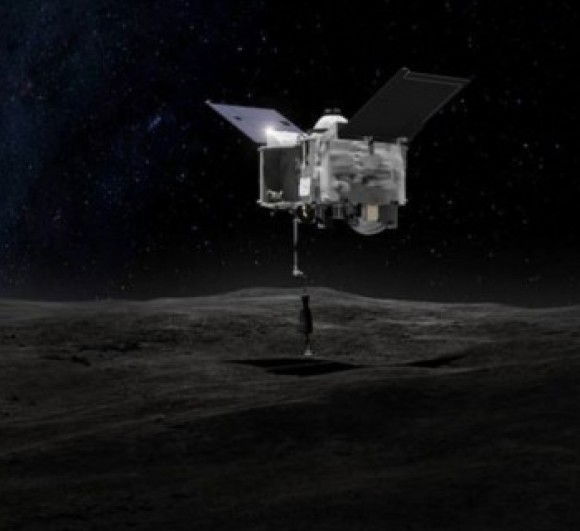
Then, in July 2020, the spacecraft will touch the asteroid for only three seconds to collect at least 60 grams of loose rocks and dust using a device called the Touch-and-Go Sample Acquisition Mechanism and store the material in a sample return capsule.
OSIRIS-REx will return the sample to Earth in September 2023, when it will then be transported to NASA's Johnson Space Center in Houston for examination.
The OSIRIS-REx mission will be the first US mission to carry samples from an asteroid back to Earth and the largest sample returned from space since the Apollo era.
"It's satisfying to see the culmination of years of effort from this outstanding team," Mike Donnelly, OSIRIS-REx project manager at NASA's Goddard Space Flight Center in Greenbelt, Maryland, said.
"We were able to deliver OSIRIS-REx on time and under budget to the launch site, and will soon do something that no other NASA spacecraft has done - bring back a sample from an asteroid," Donnelly said.
12 hours ago
Mathematicians claim proof of 167-year-old Riemann hypothesis using AI, human methods
12 hours ago
Gold, silver plummet as Fed rate fears trigger selloff
16 hours ago
US Department of Agriculture hit by cyberattack this week: Report
18 hours ago
Bulgarian FM appreciates India's efforts to resolve Black Sea conflict
18 hours ago
Manipur spurious liquor tragedy: Death toll rises to 13, around 300 fall ill
20 hours ago
'Glaring hypocrisy': Pinarayi Vijayan slams Rahul Gandhi over Israel remarks
20 hours ago
Penelope Cruz excited for first feature film under her production banner
20 hours ago
Jane Seymour takes a trip down memory lane with ‘Dr. Quinn’ Christmas nostalgia
20 hours ago
Heli Daruwala on working with Bhuvan Bam: We laughed so much on set that our stomachs hurt
20 hours ago
Madhuri Dixit recalls seeing ‘at least four or five ‘Nisha's wearing that purple sari’ from Hum Aapke Hain Koun till today
20 hours ago
Hanu-Man makers announce 'Hanuman 2– The Rise of Vanaras'; film to feature Panja Vaisshnav Tej in the lead
20 hours ago
ASHA workers' protest enters 5th day; Karnataka BJP asks Priyanka Gandhi to honour Rs 15,000 promise
20 hours ago
Bengal plans Maha model screening to detect fake transgender claimants, Bangladeshis
