




Headlines
Colombian President tries to save peace deal after 'No' vote
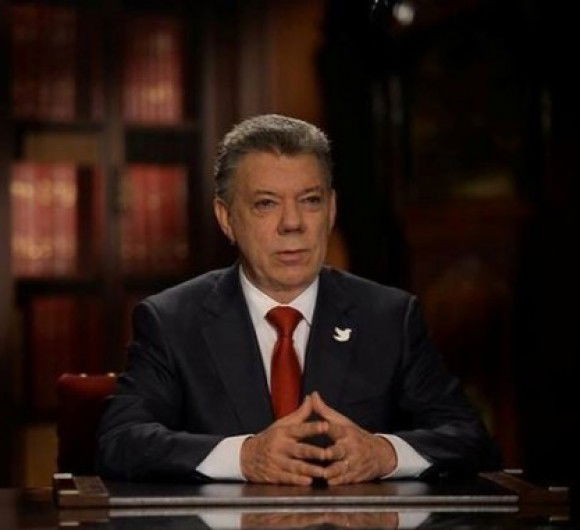
Bogota, Oct 4 Colombian President Juan Manuel Santos has appointed a team of senior officials to launch talks with the opposition on changes to a peace deal with the Farc rebel group.
Santos said this on Monday after meeting with political leaders as the peace deal -- signed last week following nearly four years of negotiations in Havana -- was rejected by a narrow margin in a referendum on Sunday, BBC reported.
Former President Alvaro Uribe, who led the "No" campaign, did not attend the meeting but appointed three negotiators to hold talks with the government.
Uribe, a senator and leader of the Democratic Centre Party, wants rebels who committed serious crimes to serve prison sentences and for some of the Farc leaders to be banned from politics.
For the agreement to be implemented, putting an end to 52 years of conflict, it would have had to be ratified by the Colombian people in a referendum.
Pre-election polls had indicated a strong victory for the "Yes" camp, but in a surprise result, 50.2 per cent voters rejected the agreement.
According to BBC, President Santos said last week there was no "Plan B" for ending the conflict, which has killed about 260,000 people.
Since the result has been announced, however, both Santos and the Farc have affirmed their determination to continue working to secure a peace deal.
"I will not give up, I will keep seeking peace until the last minute of my term," Santos said in address after the results were announced.
Farc leader Timoleon Jimenez, better known as Timochenko, said the rebels would continue to abide by a bilateral ceasefire agreed with the government.
The chief peace negotiator for the government, Humberto de la Calle, offered to resign earlier on Monday, saying he took "full responsibility for any errors in the negotiation", but Santos rejected it, instead, appointing him to lead the "national dialogue" team that will try to save the peace process.
Colombia was divided regionally with most of the outlying provinces voting in favour of the agreement and those nearer the capital and inland voting against it.
In Choco, one of the provinces hardest hit by the conflict, 80 per cent of voters backed the deal. The capital, Bogota, also voted "Yes" with 56 per cent, but in the eastern province of Casanare -- where farmers and landowners have been extorted for years by the Farc -- 71.1 per cent rejected.
Most of those who voted "No" said they thought the peace agreement was letting the rebels "get away with murder".
Under the deal, special courts would have been created to try crimes committed during the conflict.
Others were unhappy that under the agreement, the Farc would be guaranteed 10 seats in Congress.
5 hours ago
Mathematicians claim proof of 167-year-old Riemann hypothesis using AI, human methods
5 hours ago
Gold, silver plummet as Fed rate fears trigger selloff
9 hours ago
US Department of Agriculture hit by cyberattack this week: Report
11 hours ago
Bulgarian FM appreciates India's efforts to resolve Black Sea conflict
11 hours ago
Manipur spurious liquor tragedy: Death toll rises to 13, around 300 fall ill
13 hours ago
'Glaring hypocrisy': Pinarayi Vijayan slams Rahul Gandhi over Israel remarks
13 hours ago
Penelope Cruz excited for first feature film under her production banner
13 hours ago
Jane Seymour takes a trip down memory lane with ‘Dr. Quinn’ Christmas nostalgia
13 hours ago
Heli Daruwala on working with Bhuvan Bam: We laughed so much on set that our stomachs hurt
13 hours ago
Madhuri Dixit recalls seeing ‘at least four or five ‘Nisha's wearing that purple sari’ from Hum Aapke Hain Koun till today
13 hours ago
Hanu-Man makers announce 'Hanuman 2– The Rise of Vanaras'; film to feature Panja Vaisshnav Tej in the lead
13 hours ago
ASHA workers' protest enters 5th day; Karnataka BJP asks Priyanka Gandhi to honour Rs 15,000 promise
13 hours ago
Bengal plans Maha model screening to detect fake transgender claimants, Bangladeshis
