




Headlines
NASA's Opportunity Mars rover to explore fluid-carved gully
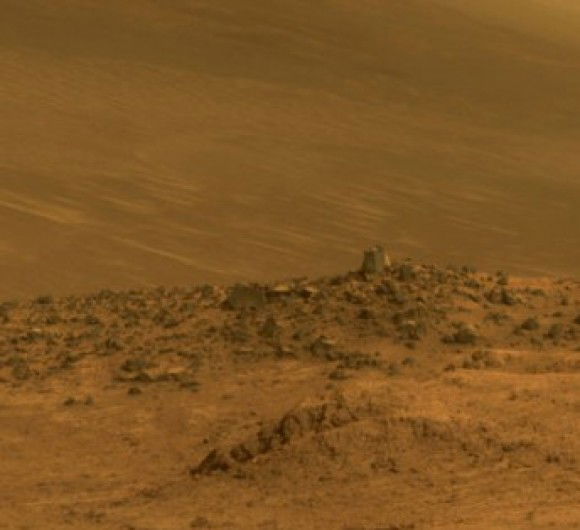
New York, Oct 8 In a first for a Mars rover, the Opportunity probe will drive down a gully carved long ago by a fluid that might have been water, according to the latest plans for the 12-year-old mission, NASA said.
"Fluid-carved gullies on Mars have been seen from orbit since the 1970s, but none had been examined up close on the surface before," Opportunity Principal Investigator Steve Squyres of Cornell University, Ithaca, New York, said in a statement.
The longest-active rover on Mars also will, for the first time, visit the interior of the crater it has worked beside for the last five years.
These activities are part of a two-year extended mission that began October 1, the newest in a series of extensions going back to the end of Opportunity's prime mission in April 2004.
Opportunity launched on July 7, 2003 and landed on Mars on January 24, 2004 (PST), on a planned mission of 90 Martian days, which is equivalent to 92.4 Earth days.
"We have now exceeded the prime-mission duration by a factor of 50," noted Opportunity Project Manager John Callas of NASA's Jet Propulsion Laboratory, Pasadena, California.
Opportunity begins its latest extended mission in the "Bitterroot Valley" portion of the western rim of Endeavour Crater, a basin 22 km in diameter that was excavated by a meteor impact billions of years ago.
Opportunity reached the edge of this crater in 2011 after more than seven years of investigating a series of smaller craters. In those craters, the rover found evidence of acidic ancient water that soaked underground layers and sometimes covered the surface.
The gully chosen as the next major destination slices west-to-east through the rim about half a mile (less than a km) south of the rover's current location. It is about as long as two football fields.
"We are confident this is a fluid-carved gully, and that water was involved," Squyres said.
"One of the three main objectives of our new mission extension is to investigate this gully. We hope to learn whether the fluid was a debris flow, with lots of rubble lubricated by water, or a flow with mostly water and less other material," Squyres noted.
The team intends to drive Opportunity down the full length of the gully, onto the crater floor.
The second goal of the extended mission is to compare rocks inside Endeavour Crater to the dominant type of rock Opportunity examined on the plains it explored before reaching Endeavour.
"We may find that the sulphate-rich rocks we've seen outside the crater are not the same inside," Squyres said.
The third main science goal of the new extended mission is to find and examine rocks from a geological layer that was in place before the impact that excavated Endeavour Crater.
5 hours ago
Mathematicians claim proof of 167-year-old Riemann hypothesis using AI, human methods
5 hours ago
Gold, silver plummet as Fed rate fears trigger selloff
9 hours ago
US Department of Agriculture hit by cyberattack this week: Report
10 hours ago
Bulgarian FM appreciates India's efforts to resolve Black Sea conflict
10 hours ago
Manipur spurious liquor tragedy: Death toll rises to 13, around 300 fall ill
12 hours ago
'Glaring hypocrisy': Pinarayi Vijayan slams Rahul Gandhi over Israel remarks
12 hours ago
Penelope Cruz excited for first feature film under her production banner
12 hours ago
Jane Seymour takes a trip down memory lane with ‘Dr. Quinn’ Christmas nostalgia
12 hours ago
Heli Daruwala on working with Bhuvan Bam: We laughed so much on set that our stomachs hurt
12 hours ago
Madhuri Dixit recalls seeing ‘at least four or five ‘Nisha's wearing that purple sari’ from Hum Aapke Hain Koun till today
12 hours ago
Hanu-Man makers announce 'Hanuman 2– The Rise of Vanaras'; film to feature Panja Vaisshnav Tej in the lead
12 hours ago
ASHA workers' protest enters 5th day; Karnataka BJP asks Priyanka Gandhi to honour Rs 15,000 promise
12 hours ago
Bengal plans Maha model screening to detect fake transgender claimants, Bangladeshis
