




America
US-China rivalry will not split the world, globalisation is here to stay: Study
Toronto, Feb 13
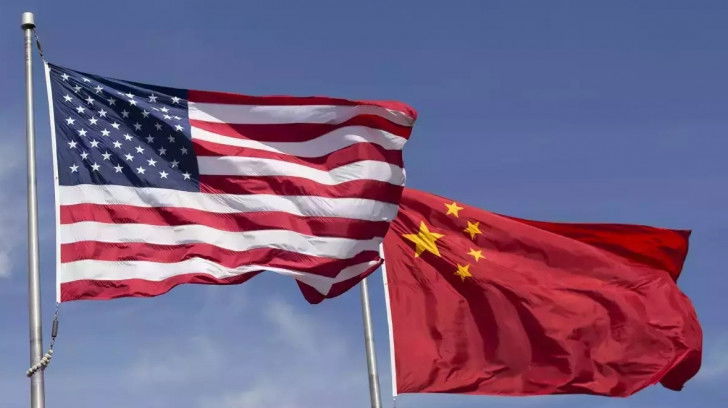
The rivalry between the U.S. and China, recently highlighted during the Chinese spy balloon crisis, is not going to escalate and split the world into two hostile camps and the era of globalisation isn't over yet, a study said on Monday.
Reports of globalisation's death are premature, according to researchers at the University of Waterloo, the University of British Columbia and the China Europe International Business School in Shanghai.
"The potential economic cost of doing this is too high for the U.S., China, their allies, and the entire world. The breakdown of globalisation ultimately hurts consumers, which we are all experiencing too well. Globalisation is not over," said Dr Victor Cui, a professor at Waterloo's Conrad School of Entrepreneurship and Business.
"We expect China's threat will slowly disappear - it is not sustainable," Cui added. "Once the fear of China's rise declines in the U.S., we expect the disengagement to slow down and even dissipate. We can be conservatively optimistic there will be changes."
The U.S. believes that the suspected Chinese surveillance balloon that it shot down on February 4 over Atlantic Ocean, was part of a wider effort by Beijing to spy on military assets in other countries, including India.
However, beyond economic realities, the researchers found that the U.S.-China rivalry is based, in part, on misunderstanding.
For example, China's intentions to seek 'self-reliance' were largely defensive while being interpreted in Washington's narratives as solely aggressive.
For their part, China's communist leaders bristled at what they saw as American attempts to limit China's growing economic and political power, said the researchers in a paper published in the Journal of International Business Studies.
The authors suggest that Washington may have overstated China's techno-nationalistic threat to the liberal world order for a few reasons.
First, China increasingly centralises top-down control over its innovation effort, which is unlikely to sustain its rapid technological advancement.
Second, China may not be able to continuously inject the funding required to sustain its technology innovation because of its continuing economic growth decline.
"Moreover, China also faces a growing shortage of young productive workers in the next decade due to its former one-child policy," they argued.
The researchers said that assumptions that China's rapid pace of technology innovation will accelerate, and that China may establish its own technological hegemony and surpass the U.S. in some strategic fields are overstated.
The researchers argued the entire world would benefit if the U.S. and China acted as partners instead of rivals, as they can more effectively manage existential global challenges such as inflation, climate change and future pandemics while minimising the risks of military confrontations.
7 hours ago
IOCUSA Condemns ‘Purification’ Ritual Following Mallikarjun Kharge’s Haldwani Rally
7 hours ago
"No account on any front will remain unsettled": Israeli Defence Minister vows after strike in Lebanon kills 11
7 hours ago
"May India-Israel Special Strategic Partnership grow even stronger": PM Modi thanks Netanyahu for I-Day wishes
7 hours ago
IPSF 2026 Brings Syro-Malabar Community Together in a Grand Celebration of Faith, Sports and Fellowship in Texas
7 hours ago
Tiranga raised in New York as city gears for India Day Parade
7 hours ago
Trump posts photo with North Korean leader Kim, says 'we get along great'
7 hours ago
Israeli strike kills senior Hezbollah commander in Lebanon
7 hours ago
Strait of Hormuz crisis underscores need for diversified energy routes: Report
1 day ago
Trump bets on drug prices to win midterms
1 day ago
Trump declares US will take over Hormuz as US territory ‘pretty soon’
1 day ago
Mary Millben hails India’s unity, PM Modi
1 day ago
Trump vows to abolish US sanctuary cities
1 day ago
Trump claims historic fall in US violent crime
