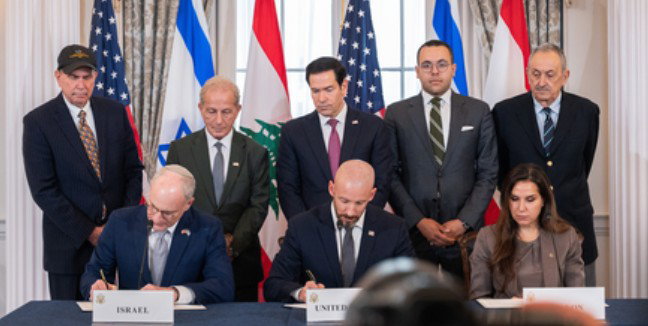
Washington, June 27
The United States, Israel and Lebanon on Friday signed a trilateral framework agreement that Washington described as the first step towards ending decades of conflict along Israel's northern border, restoring Lebanese sovereignty and creating a pathway for the disarmament of Hezbollah.
The agreement, signed in Washington with US mediation, establishes what Secretary of State Marco Rubio called "a framework for lasting peace and security" and creates a US-facilitated Military Coordination Group for Lebanon to oversee its implementation.
"Today is a good day in that we are happy to announce the – a framework agreement between the sovereign Government of Lebanon and of course the Government of Israel, with the mediation and support of the United States of America, that begins to put in place a framework for lasting peace and security. And that's what these two nations deserve," Rubio said during the signing ceremony.
The framework aims to restore Lebanon's sovereignty, dismantle Hizballah's military infrastructure and enable Israeli forces to return to their borders once security threats are removed.
According to the State Department, the agreement "establishes a clear and structured process to restore Lebanon's sovereignty, disarm Hizballah and dismantle its terrorist infrastructure, and enable Israel to return to its borders once that threat to its citizens is removed."
It also establishes the Military Coordination Group for Lebanon (MCG4L), facilitated by the United States, to help both sides implement the agreement.
Rubio acknowledged that implementation would be difficult but said the agreement marked an important beginning.
"As I said today, as I told all the parties here today, it's the beginning of the beginning. There is a lot of work ahead. We don't in any way underestimate the difficulty of the task ahead. But we understand the importance of it, how vital it is, and we are honoured to have played a part in bringing this together," he said.
He said the people of Lebanon had "suffered tremendously now for decades as a result of outside interference in their affairs" and deserved "a prosperous and peaceful country".
Rubio also stressed Israel's security concerns, particularly for residents of northern Israel who have faced repeated attacks launched from Lebanese territory.
"The people of Israel deserve to live in peace and security – the people of northern Israel in particular, who have been targeted repeatedly by terrorist attacks launched from the territory of Lebanon," he said.
Lebanese Ambassador to the United States Nada Hamadeh Moawad described the agreement as "a first step on the road to restoring Lebanese sovereignty and territorial integrity, securing a permanent and final cessation of hostilities, enabling our people to go back to their land, and allowing all Lebanese to live in peace, security, and prosperity."
Israeli Ambassador Yechiel Leiter said the agreement represented a decisive shift in regional security.
"In this performance-based trilateral framework agreement, Iran is out, Hizballah is out, and the road to peace between Israel and Lebanon is in," he said.
The State Department said Washington would remain fully engaged in implementing the agreement and would immediately provide 100 million dollars in humanitarian assistance in coordination with the United Nations. It also said the Department of War was prepared to reimburse the Lebanese Armed Forces with more than 30 million dollars under existing authorities to strengthen the country's ability to establish sovereignty across its territory.