Washington, June 30
Canada sees India as the "most logical place" to diversify its trade and investment partnerships as countries rethink global supply chains amid geopolitical uncertainty, Canada's Ambassador to the United States, Mark Wiseman said.
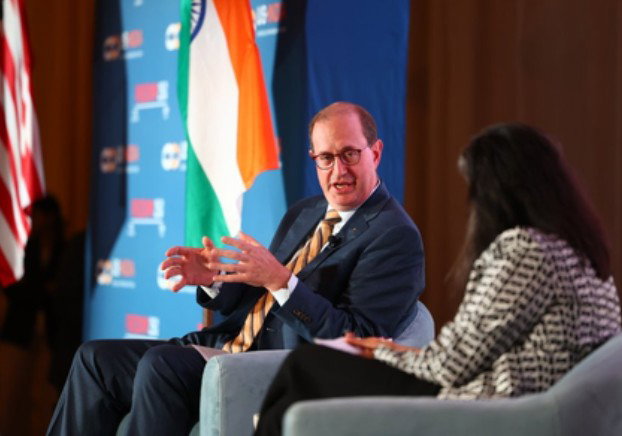
Speaking at the US-India Strategic Partnership Forum (USISPF) Leadership Summit, Wiseman said the changing global economic landscape had reinforced the need for countries to build more resilient and diversified partnerships without weakening existing relationships.
"The relationship between Canada and India, which I think is on an excellent path, is an example of that diversification," Wiseman said.
"And for Canada, a very logical, perhaps the most logical place to look in the world to extend and diversify our trading relationship is India."
Wiseman said the Canada-US free trade relationship remained one of the world's strongest examples of economic integration, with $2.4 billion worth of goods and services crossing the border every day and bilateral trade rising 27 per cent since the US-Mexico-Canada Agreement (USMCA) came into force in 2020.
"North America should be viewed as a shining example of how trade integration can benefit countries and indeed citizens across the border," he said.
At the same time, he said recent geopolitical developments had prompted countries to diversify supply chains and economic partnerships.
"The change in posture of the United States... has brought to the fore an understanding that countries around the world need to be more self-sufficient, need to be more resilient, and need to think in a more diversified way," Wiseman said.
He stressed that diversification should complement, rather than replace, Canada's close economic relationship with the United States.
"We don't want to give that up, and the US doesn't want to give it up with us. But we can all benefit from being more diversified," he said.
Turning to technology, Wiseman said artificial intelligence offered an opportunity for Canada, India and the United States to build a new model of trilateral cooperation.
He said India contributed engineering talent and the ability to scale technology, Canada brought world-class AI research and energy resources, while the United States remained a leader in frontier technologies.
"I think within AI... we're in the early stages of being able to develop those partnerships."
"What India brings to the table is an incredibly talented... human resource... an ability to innovate very, very quickly."
"If you think what Canada can bring to that table... we are a centre for AI research, but we're also a centre for energy."
Wiseman argued that no country could succeed alone in the next phase of technological development.
"I think countries thinking that they can do that alone is a very narrow-minded way of thinking."
"We're gonna have to collaborate."
"We're each gonna have to bring to the table what is required for this next phase of human development."
He said governments should focus on creating conditions for innovation rather than directing it.
"The role of government is to set the conditions and create a permissive environment where the private sector and business can be in a position to take advantage of the opportunities."
"We need government not to regulate and get in the way, but... to set the conditions that are required by private enterprise."
Wiseman highlighted several new areas of Canada-India cooperation, including a strategic energy partnership covering LNG, LPG, uranium, hydrogen and solar energy, collaboration between the Canadian Space Agency and the Indian Space Research Organisation, and agreements on critical minerals.
He said these initiatives would support both manufacturing and the digital economy by strengthening the infrastructure underpinning future technologies.
Wiseman said stronger bilateral partnerships would make countries more resilient and prosperous.
"Having strategic autonomy doesn't mean that you're going it alone."
"Having strategic autonomy means that you're building relationships around the world that give you more flexibility in your own economy and make you more resilient."
He concluded that people-to-people ties would remain the foundation of long-term cooperation.
"Ultimately, anything we do in business, in trade, in commerce, in government, is about people-to-people relationships."
"If we've increased those people-to-people relationships... the world will be a much better place."
"I'm an optimist. I feel good about us being able to achieve that."