Asheville, Aug 31
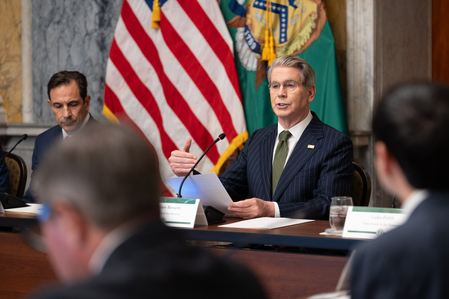
The United States has put economic growth, lighter financial regulation and action against global trade imbalances at the centre of the G20 agenda, Treasury Secretary Scott Bessent said as finance ministers and central bank governors met in Asheville, North Carolina.
Opening the meeting, Bessent said the Trump administration was returning the forum to the economic purpose for which it was created.
“When the G20 first convened in the late ’90s, its mandate was clear to promote cooperation and pursuit of economic growth,” he said. “But over the decades, mission creep has knocked the swarm off course. This year, under President Trump, we’re getting back to the basics.”
Bessent outlined five priorities for the US-led G20 process. Economic growth was the first and most important, he said. It depended on abundant resources, clear rules and strong markets.
The United States was bringing private-sector business leaders and G20 policymakers together for the first time to identify obstacles to growth and develop reforms to remove them, he said.
That partnership would also guide efforts to modernise financial regulation and supervision.
“Smart rules preserve competence without smothering initiative,” Bessent said. “So the G20 is exploring ways to streamline and reform regulatory approaches to reduce unnecessary burdens, protect market integrity, and supply businesses with the certainty they need to invest and innovate.”
The third priority was confronting persistent global imbalances. Bessent said finance ministers and central bank governors broadly agreed that addressing excessive imbalances was in the interest of both surplus and deficit countries.
He criticised policies that favour a country’s own exports at the expense of other economies.
“A durable global economy cannot rest on beggar thy neighbour acts that stifle fair market-based competition,” he said.
The G20 was directing the International Monetary Fund and other international organisations to strengthen their analysis and engagement on the issue, he added.
Bessent said the group would also address sovereign debt problems, particularly in emerging markets and developing economies. The objective was to make debt restructuring faster, more transparent and more predictable.
Financial literacy was the fifth priority. Bessent highlighted the launch of Trump Accounts in the United States, saying they would help young Americans acquire a stake in the economy and learn about finance.
“Financial literacy is a foundational skill akin to reading and writing,” he said.
Bessent also thanked the European Union and the European Central Bank for supporting US economic action against Iran.
Federal Reserve Chairman Kevin Warsh, attending the G20 finance track for the first time in his new position, described the global economy as being at “a hinge point in history”.
Warsh said earlier fears of prolonged low growth and insufficient investment no longer reflected economic conditions.
“Secular stagnation seems like a description of a past long ago,” he said. “The new period is one of secular growth.”
He also rejected the once-common idea of a global savings glut, in which capital remained unused because of a shortage of investment opportunities. “If I were to try to characterise this moment, it would be one of a global investment surge,” Warsh said.
The G20 brings together 19 countries, the European Union and the African Union. Its members account for about 85 per cent of global economic output, more than three-quarters of international trade and roughly two-thirds of the world’s population.
The forum was established in 1999 after a series of financial crises exposed the need for broader international economic coordination. Its finance track deals with global growth, financial stability, international taxation, development financing and sovereign debt.