








AMERICA
From High Peaks to Silver Screens: The Epic Journey of Pashmina
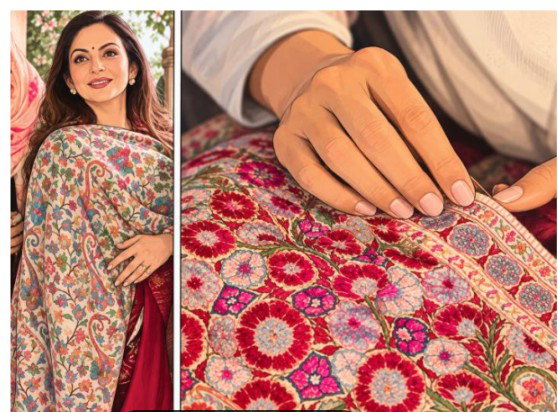
The Fiber of Mythology
Pashmina is far more than a mere luxury accessory; it is a profound meeting point where the raw resilience of nature, the rhythmic cycles of pastoral life, and a centuries-old craft tradition converge.
To understand Pashmina is to look past the showroom glass and trace a remarkable journey that begins in the oxygen-thin, high-altitude deserts of Ladakh and ends within the romantic, dreamlike narratives of Bollywood cinema. This is the story of how a biological survival mechanism became "soft gold."
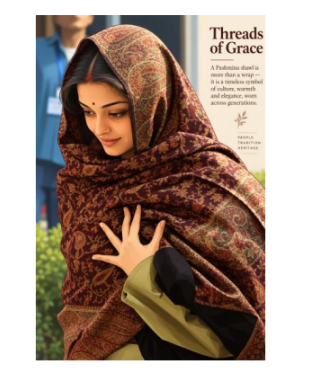
The Genesis: The Luxury of Survival
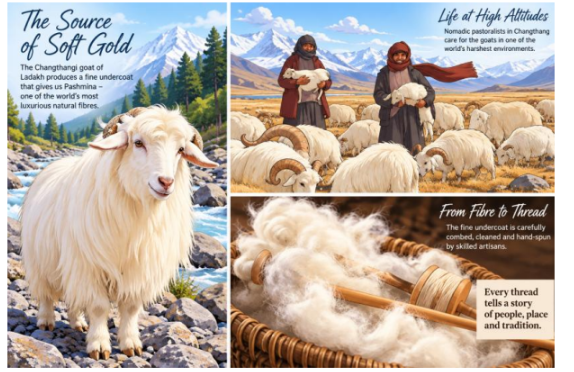
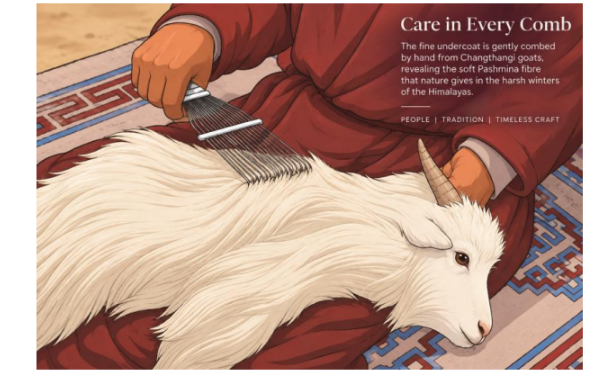
The journey begins with the Changthangi (or Changra) goat, a resilient animal that thrives in the extraordinarily harsh Changthang cold deserts of Ladakh. The luxury of the final product is inextricably linked to the brutality of its origin. To survive temperatures that plummet to -40°C, these goats develop a fine undercoat of 12–15 micron fibers—a biological response that provides natural insulation. The softer the fiber, the better the protection it once afforded the animal against the Himalayan winter.
The Pastoral Economy The production of raw Pashmina is the lifeblood of the Changpa nomadic and semi-nomadic pastoralists. Their contribution is defined by:
• Environmental Extremes: Managing livestock in a landscape where survival itself demands
immense human and animal resilience.
• Rhythms of Nature: Herders wait for the goats to shed their winter undercoats naturally as the seasons turn.
• Manual Combing: Unlike shearing, the fleece is collected by carefully combing the goats,ensuring the delicacy of the fiber is preserved from the very first step.
The Alchemical Process: From Fiber to Textile
The transformation of raw fleece into a Kashmir heirloom is an exercise in "patience becoming a craft." It is a labor-intensive value chain where hundreds of hours of human touch refine the harvest
of the high peaks.
1. Natural Shedding and Combing: Pastoralists collect the fine fleece during the natural
shedding cycle.
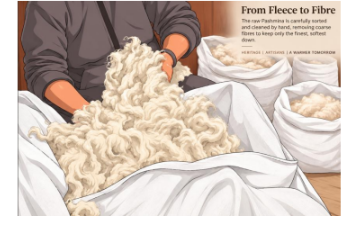
2. Sorting and Scouring: The raw wool is manually color-sorted. It must be cleaned and
"dehaired" to separate the precious, fine Pashmina from coarser outer fibers and impurities.
3. Hand-Spinning and Hand-Weaving: Artisans transform the clouds of processed fiber into
delicate yarn and eventually into a textile. This stage requires a level of skill passed through generations, where the "human touch" is the only way to manage such fine thread.
4. Embroidery and Finishing: The final stages involve intricate needlework and finishing,
turning the fabric into a piece of wearable history.
The ₹1,500 Question: Decoding Value and Authenticity
In contemporary markets, a consumer may find shawls labeled "Pashmina" for ₹1,500, while
genuine, hand-crafted pieces command ₹10,000 to ₹15,000 and above. This disparity is often fueled by the proliferation of fakes; indeed, dramatic claims on social media suggest that as much as 90% of the "Pashmina" in the market is not authentic. While such figures require authoritative evidence, the underlying concern is valid.
Factors Affecting Price and Value
➢ Fiber Quality | The purity and micron-level fineness of the Ladakh Pashmina.
➢ Processing Methods | The intensity of manual cleaning, dehairing, and sorting.
➢ Workmanship | The hundreds of hours invested in hand-spinning and weaving.
➢ Design & Embroidery | Complexity of the traditional needlework and artisanal skill.
➢ Provenance | Verification of the geographic origin and historical craft tradition.
➢ Authentication and GI
To combat misinformation, two critical protections exist: the Kashmir Pashmina and Pashmina Wool of Ladakh Geographical Indication (GI) tags. The Craft Development Institute in Srinagar operates a dedicated Pashmina Testing and Quality Certification Centre to provide official authentication.
The Buyer’s Checklist
When purchasing, buyers should move beyond "softness" and ignore unreliable "home tests" like the ring or burn test. Instead, ask:
• Provenance: Where did the shawl come from?
• Methodology: How was it made? Is it hand-spun and hand-woven?
• Certification: Can the seller provide official GI or authentication details from the Srinagar Testing Centre?
Pashmina in the Imagination of Bollywood
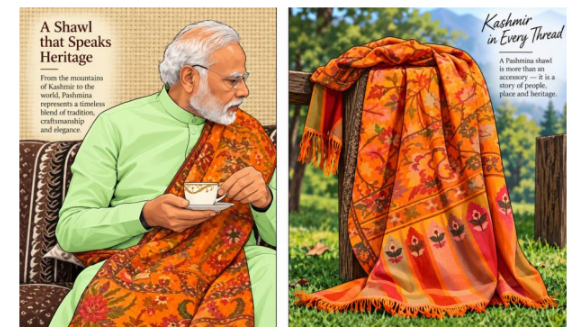
If the mountains gave Pashmina its origin, Hindi cinema gave it a mythology. However, as a textile historian, I must offer a journalistic distinction: a shawl appearing in a Kashmir-set film should not automatically be labeled as authentic Pashmina. Costume records and provenance matter even on the silver screen.
Iconic Film Case Studies
• Kabhi Kabhie (1976): Directed by Yash Chopra, this film established the visual vocabulary of Indian romance. Against the Kashmir backdrop, the ensemble cast—including Amitabh Bachchan, Raakhee, Shashi Kapoor, Waheeda Rehman, Rishi Kapoor, and Neetu Singh—
helped cement the shawl as a symbol of elegance.
• Bajrangi Bhaijaan (2015): In this setting, the Pashmina shawl signaled refinement. Kareena Kapoor Khan’s character was identified by contemporary coverage as wearing authentic Pashmina, tying the character to the prestige of the region.
• Fitoor (2016): Here, the fabric transitioned from costume to the very title of a love song.Composed and sung by Amit Trivedi, with lyrics by Swanand Kirkire, the song "Pashmina" integrated the fiber into the romantic lexicon. Behind the scenes, the connection was personal: actor Aditya Roy Kapur reportedly gifted a 100% pure Kashmiri hand-embroidered Pashmina to Katrina Kaif.
• Raazi (2018): Starring Alia Bhatt, this film used Pashmina and pherans with traditional floral embroidery to construct a "sense of place," using the textile to build the visual identity of a Kashmiri woman.
The Economic Future: 2026 Policy and Sustainability
The future of this craft is inseparable from the future of the Changpa herders. In 2026, the Ladakh Administration implemented aggressive interventions to support the value chain.
Key 2026 Statistics & Initiatives:
• Accelerated Production: Raw Pashmina collection reached 19 metric tonnes by July 2026, a massive jump compared with the 16 metric tonnes collected during the whole of 2025.
• Financial Support: At the Changthang Nomadic Festival in August 2026, it was reported that ₹1.10 crore was transferred via Direct Benefit Transfer (DBT) to over 1,200 herders.
• Revolving Fund: An ₹8-crore fund was established for cooperative procurement to ensure
timely payments.
• Market Linkages: In July 2026, a Buyer–Seller Meet in Srinagar was organized to bridge the gap between herders, exporters, and traders, strengthening direct price realization.
Incentive Breakdown: The 25% production-based top-up incentive is strategically allocated:
• 60%: Scientific breeding of Pashmina goats.
• 20%: Modern combing equipment and infrastructure.
• 20%: Household and personal needs of the pastoralists.
The Ladakh Pashmina Development Board, established in June 2026, now serves as the institutional mechanism for productivity, processing, and promotion.
The Real Luxury
Pashmina is called "soft gold" not merely for its price, but for the story that price represents. The real luxury lies in the traceability of the fiber—from a goat surviving a Himalayan winter to a pastoralist walking the high-altitude landscape and an artisan guiding thread at a loom. While Bollywood has masterfully captured the movement and softness of the shawl, the elegance of Pashmina existed long before the camera arrived. Its value is found in everything that happens before that softness ever touches your shoulders.


