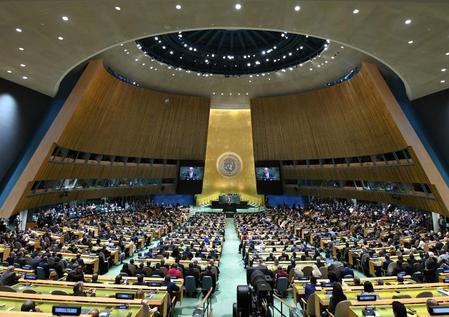
“We did not stop the genocide in Rwanda. We did not stop the genocide in Srebrenica. We must stop the genocide in Gaza.”
Those were among the concluding words of Slovenian President Nataša Pirc Musar before the United Nations General Assembly, followed by her declaration that there were no longer any excuses. Her words were powerful and received worldwide attention. Whether one agrees with her legal characterization of the war in Gaza as genocide or not, there can be little disagreement that Palestinian civilians have endured enormous suffering and that the international community has a responsibility to protect innocent human life.
President Musar had made a similar broader point only a few months earlier. Speaking on Slovenia’s Statehood Day, she referred to Sudan and Myanmar, where, in her words, innocent people were dying ‘hidden from the eyes of the world,’ even while Gaza remained continuously before the global public. Her larger message was very simple: humanity is indivisible.
That is where the current human rights debate troubles me. Gaza appears to have sucked almost all the oxygen out of the discussion of human-rights violations taking place elsewhere in the world. Gaza deserves attention, and the suffering of Palestinians should never be minimized. However, human rights, by their very definition, are universal. They cannot become selective depending on geography, religion, politics, television coverage, or the ideological preferences of those who claim to defend them.
Consider Sudan. When the Rapid Support Forces captured El Fasher in Darfur, the United Nations documented more than 6,000 people killed in only three days and said the actual toll was undoubtedly higher. Civilians were reportedly executed, attacked while attempting to flee, subjected to sexual violence and targeted along ethnic lines. Sudan has also become one of the world's largest displacement and humanitarian crises. These are staggering atrocities. Yet the tragedy seldom generates the sustained attention in the United States that Gaza has commanded.
Nigeria provides another example. The violence there is admittedly complex, involving religious extremism, ethnic rivalries, land disputes, criminal gangs and weak governance. Muslims have also been victims of terrible violence. Nevertheless, Christian communities have suffered enormously. Open Doors reported that 3,490 Christians were killed for faith-related reasons in Nigeria during its latest annual reporting period, averaging close to ten every day. Nigeria accounted for the overwhelming majority of such documented Christian killings worldwide during that period.
These are not insignificant numbers. Churches are attacked, worshippers kidnapped, and entire communities live under constant insecurity. Nevertheless, one rarely witnesses the type of sustained demonstrations, campus encampments, and national political mobilization on behalf of Nigerian victims that we have witnessed over Gaza.
Syria is another tragedy that seems to be disappearing from public consciousness. The fall of the Assad regime has not brought security to many religious minorities. USCIRF reported this year that Syria's transitional authorities have failed adequately to protect religious freedom and that both state and non-state actors have committed sectarian violence and extrajudicial killings against Alawites, Druze, Christians and other communities. ISIS and other extremist elements continue to present additional threats to religious minorities.
Then there is Nagorno-Karabakh. Following Azerbaijan's military operation in September 2023 and the preceding restrictions on the Lachin Corridor, more than 100,000 ethnic Armenians—virtually the entire Armenian population of Nagorno-Karabakh—fled to Armenia within a matter of days. The United States State Department documented that enormous exodus. Azerbaijan has maintained that Armenians could remain or return under its sovereignty, but the fact remains that an ancient Armenian Christian community was almost completely emptied from the territory.
How quickly the world moved on! In my own homeland of India, Manipur remains another painful example. Since ethnic violence erupted there in May 2023, Human Rights Watch reports that more than 260 people have been killed and more than 60,000 displaced. The earlier phase of the conflict involved predominantly Hindu Meitei and predominantly Christian Kuki-Zo communities, although subsequent violence has expanded to involve other ethnic groups. Hundreds of homes and churches have been destroyed, and large numbers of people remain unable to return safely to their communities. During just the first weeks of the 2023 violence, a Christian organization cited by Human Rights Watch reported that more than 200 churches had been burned or destroyed. Manipur has received some international attention, but hardly anything proportional to the scale and duration of the tragedy.
Iran provides yet another chilling example. During the nationwide protests that broke out in late 2025 and intensified in January 2026, Human Rights Watch reported evidence of countrywide massacres. It said thousands of protesters and bystanders were believed to have been killed. Tens of thousands were subsequently reported arrested, with allegations of torture, enforced disappearances and the threat of arbitrary executions.
China continues its systematic repression of religious communities as well. USCIRF reported this year that the Chinese government has intensified its policy of “sinicization,” tightening control over Uyghur Muslims, Tibetan Buddhists and other religious communities. Its 2026 annual report stated that at least half a million predominantly Muslim Uyghurs and members of other Turkic minorities remained imprisoned or confined in internment facilities in Xinjiang. Christians who worship outside state-approved structures also continue to face government restrictions and repression.
None of these tragedies should diminish our concern for Gaza. However, taken together, they raise a legitimate question about the consistency of today's human-rights movement. That is particularly true when one looks at sections of the so-called progressive movement in the United States.
The mobilization over Gaza has been extraordinary. American university campuses witnessed hundreds of demonstrations and encampments, occupations of buildings, demands for divestment and confrontations with university administrations and police. In a matter of weeks in 2024, Reuters reported more than 2,600 arrests at over 100 protests in 39 states. The movement became one of the largest episodes of American student activism in years.
Those students had every right to protest peacefully. Freedom of speech and peaceful assembly are fundamental American freedoms, and they must be protected even when the message is unpopular. However, what troubles me is the selectivity. I do not recall anything remotely approaching that level of mobilization when thousands were being massacred in Sudan, when Christians were being killed almost daily in Nigeria, when Armenian Christians fled Nagorno-Karabakh, when tens of thousands were displaced in Manipur, when Iranian protesters were being gunned down, or when Uyghurs were being incarcerated in China.
Therefore, it is reasonable to examine whether, for some parts of the progressive movement, Gaza has become more than a human-rights cause. The rhetoric surrounding many demonstrations has increasingly embraced broader demands against American institutions, corporations, universities, law enforcement and traditional U.S. foreign-policy relationships. Protesters themselves have identified objectives ranging from ending U.S. military support for Israel to forcing universities to divest from companies they regard as complicit in the war.
There is nothing inherently illegitimate about advocating any of those policies. Nevertheless, when a human-rights movement displays tremendous energy for one particular conflict while staying largely silent about comparable atrocities elsewhere, one is entitled to wonder whether ideology has begun to compete with humanitarian concern.
I would not presume to know the motivation of every student carrying a placard or every progressive activist marching down a street. Many undoubtedly are genuinely horrified by Palestinian suffering. Some Jewish Americans themselves participated prominently in the demonstrations, and many protesters sincerely believed they were acting in accordance with universal humanitarian principles.
However, there is also an increasingly visible tendency among parts of the activist left to view almost every major American institution through the prism of oppression and resistance. Gaza then appears to becomes another vehicle for confronting the political, economic and social structure of the United States. Whether that is the intention of the movement as a whole or not, the appearance of selective outrage weakens its moral credibility.
Human rights cannot be fashionable rights. If we oppose the killing of innocent civilians, we should oppose it everywhere. If we condemn ethnic cleansing, the religion or nationality of the victim should make no difference. If religious persecution is wrong, it is wrong whether the victim is a Muslim Uyghur in China, a Christian in Nigeria, a religious minority in Syria or anyone else.
A Palestinian child buried under rubble is precious. So is a Sudanese child fleeing El Fasher. So is a Christian child terrorized in Nigeria, an Armenian forced from an ancestral home, a displaced Kuki family in Manipur or an Iranian youngster shot for demanding freedom.
President Musar's words about Gaza were compelling. However, I find her broader declaration that humanity is indivisible even more important. She herself has reminded us that Sudan and Myanmar are suffering largely outside the glare of world attention. Therefore, the answer is not to speak less about Gaza. It is to speak more loudly on behalf of everyone else.
Human rights will retain their moral force only when they apply equally to friend and foe, majority and minority, Christian, Muslim, Jew, Hindu or unbeliever. Once we select victims according to our political agenda, human rights cease to be universal principles and risk becoming another weapon in the political battles of our time.
There should be enough oxygen in humanity's conscience for every victim. Otherwise, selective outrage may ultimately do as much damage to the credibility of the human-rights movement as silence itself.