Washington, Oct 17
President Donald Trump has portrayed the United States as an economic and military powerhouse under his leadership, claiming that tariffs are bringing manufacturing jobs back, Washington is outpacing China in the race for advanced artificial intelligence and the conflict with Iran is nearing an end.
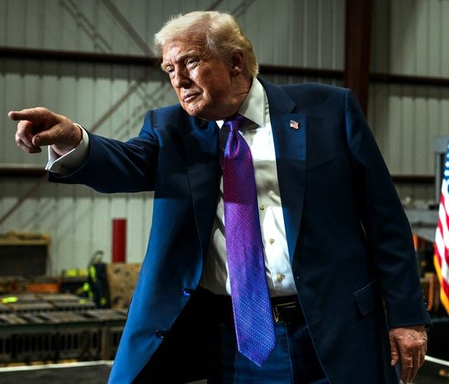
Addressing Republican supporters at a fundraising event in Miami Friday night, Trump offered an expansive defence of his administration's record ahead of the November 3 midterm elections, linking economic growth, energy security, military operations and technological leadership to his party's electoral prospects.
The President said his administration had transformed the country's economic position through tax cuts, deregulation and policies designed to encourage domestic investment.
"We have the hottest country in the world right now," Trump said, contrasting current economic conditions with what he described as the situation before his return to the White House.
He claimed that $21 trillion was being invested or committed for investment in the United States, with new factories being built across the country. The figure was not independently substantiated in the remarks.
Trump said tariffs had played a central role in persuading automobile manufacturers to expand production in the United States rather than overseas.
He named Canada, Mexico, Japan, South Korea and Germany among countries that had benefited from the earlier movement of automobile production away from America.
"It's all coming back because of tariffs, and because of this presidency," he said.
The President also highlighted competition with China in advanced technology, describing artificial intelligence as an increasingly important measure of national power.
He said the emerging contest was moving beyond conventional AI towards what he called superintelligence, or SI.
"Whoever wins the superintelligence race, is going to be the winner," Trump said.
He asserted that the United States was ahead of China in developing the technology and suggested that no other country was currently competing at the same level.
"We're leading China. China's second, and there essentially is no third," he said.
The President also discussed his recent interaction with Chinese President Xi Jinping, claiming that Xi had acknowledged America's economic progress.
Turning to foreign policy, Trump predicted that the conflict involving Iran would end soon and said its conclusion would bring substantial relief to global energy markets.
"We're going to win it very soon, one way or the other," he said.
Trump predicted that oil prices would fall sharply once the conflict ended, although he offered no specific timetable or supporting market analysis.
He claimed that US military operations had destroyed much of Iran's naval and air capabilities and eliminated its ability to pose a nuclear threat.
Those battlefield assessments were not independently verified in the supplied material.
The President also praised American military operations in Venezuela, describing the country's oil reserves as strategically important to the United States.
He claimed that the two countries together possessed a substantial share of global oil resources and said large quantities of Venezuelan crude were being extracted.
Trump linked energy production to his broader argument that the United States had regained economic and strategic strength.
On immigration, he repeated allegations that millions of people had entered the country illegally under former President Joe Biden, including criminals and individuals released from prisons abroad.
The President credited his administration with strengthening border security and reducing inflation, claiming that price increases had slowed considerably in recent months.
He also addressed the approaching midterm elections, praising Republican National Committee leadership and arguing that his campaign rallies were helping mobilise voters who might otherwise stay home.
He also attacked a Democratic Senate candidate in Michigan and expressed support for Republican Mike Rogers, making allegations about his opponent's political associations that were unsupported by evidence in the remarks.
The President acknowledged that governing parties traditionally face difficulties in midterm elections but argued that his administration's economic and national security record would help Republicans overcome that pattern.
The November 3 elections will determine control of Congress during the remainder of Trump's presidential term. Economic conditions, immigration, foreign policy and the cost of living have featured prominently in the campaign.
Trump returned to the White House in January 2025 after winning the 2024 presidential election. His administration has pursued higher tariffs, stricter immigration enforcement and expanded domestic energy production while placing technological competition with China at the centre of its economic and national security agenda.