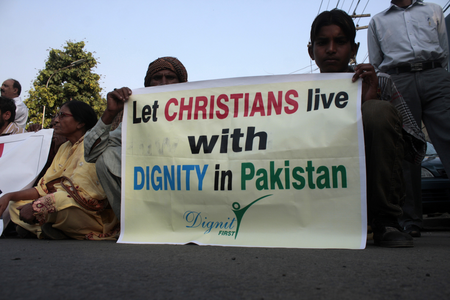
Islamabad, Nov 9
The Supreme Court of Pakistan has rejected the appeal of a Christian man named Qaiser Ayub and confirmed the death sentence announced againhim for blasphemy, leaving him with very few legal options. The same bench had acquitted his younger brother, Amoon Ayub after they found the evidence weak. He was released after spending almost 12 years in prison, a report has detailed.
The story started in 2011 with allegations that blasphemous material appeared on a website related to Qaiser Ayub. He has repeatedly contended that he had shut down the website in 2009 and someone else had reactivated it, leaving his name in the copyright notice. According to him, the offending content was posted by a third party exploiting an abandoned site, A Sahara Alexander wrote in 'Bitter Winter'.
Qaiser Ayub and Amoon Ayub were arrested in 2014 and a trial court sentenced them both to death in 2018. In 2022, the Lahore High Court confirmed the convictions. During the court proceedings, the prosecution has largely built its case on electronic evidence.
Human rights activists have raised questions on how this material was authenticated and whether an investigation was conducted on who actually controlled the website when the contest was posted. Pakistan's Supreme Court found the evidence insufficient to sustain Amoon Ayub's conviction, yet strong enough to declare the death sentence for Qaiser Ayub. Observers may think how the same evidence could lead to different conclusions.
The Centre for Legal Aid, Assistance and Settlement (CLAAS), a UK-based organisation that has supported the two brothers during the court proceedings, voiced concern about the decision announced by the supreme court and called for using every legal means on Qaiser Ayub’s behalf.
Meanwhile, the Human Rights Commission of Pakistan (HRCP) said that Pakistan’s religious minorities continue to face systematic persecution, discrimination and denial of equal rights, with the abduction and forced marriages of Hindu and Christian girls, blasphemy cases and extremist attacks highlighting persistent failures to protect vulnerable communities.
In its latest report titled 'Sanctuary Denied: Freedom of religion or belief in 2025/26', the HRCP said that girls from Christian and Hindu communities continued to face abduction and forced marriage, compounded by poverty and inadequate police responses.
“Girls from minority communities continued to disappear and be coerced into wedlock by older Muslim men. An underage Christian girl’s ordeal is included in the report alongside that of Hindu girls. Weak police response and poverty worsened the struggles of the victims and their families. Alarmingly, a Hindu human rights activist posted on a social platform about alleged threats from a right-wing party for his activism against forced marriages of Hindu girls in Sindh," the rights body stated.
The report highlighted persistent misuse of blasphemy laws in Pakistan, noting that hundreds of people accused of blasphemy remain in legal limbo, while the alleged perpetrators of an organised entrapment network have yet to be investigated.
It also documented attacks on the Ahmadiyya community, including two extremist attacks in Chenab Nagar, alongside increasingly overt attempts to exclude Ahmadis from public and commercial life.
“The weaponisation of blasphemy law continued during the reporting period, with recurring patterns of personal vendetta, extortion and misguided religiosity driving the accusations. Although religious minorities are common targets, an influential scholar of the majority religion was also accused of blasphemy after making comments about the Christian faith,” the report mentioned.