New Delhi, Nov 26
The 26/11 attacks were one of the most horrific and audacious attacks that India has witnessed, with a siege of Mumbai that lasted nearly 60 hours, and led to the killing of 166 people by ten terrorists of the Lashkar-e-Taiba who spread across multiple locations.
While the attack was audacious in nature, many argue that the response was quite weak and Pakistan needed to be punished harder for nurturing and harbouring the Lashkar.
The investigators were fortunate enough to capture one of the terrorists (Ajmal Kasab) alive. Had it not been for his interrogation, it would have been very hard to link the attack to Pakistan.
Despite the confession by Kasab, Pakistan continued to deny any link with the attack and even wiped out all traces of his home and family members in Faridkot, a village in the Kara district of Punjab province.
The experts note that while the response post the attack may not have been up to the mark, there were several lessons learnt.
Prime Minister Narendra Modi post his swearing in, in May 2014 vowed to fight terror. This led to the evolution of the kinetic strategy, which involved a more muscular approach to counterterrorism.
During the attacks, there were multiple flaws that were exposed. This included a complete lack of Intelligence, ill-equipped personnel of the Mumbai police, lack of coordination on the ground, and delayed response in bringing in the National Security Guard (NSG) to Mumbai from Delhi, the official said.
There were several misses when it came to Intelligence.
The landing of the ten terrorists in Mumbai prior to the attacks remained largely unknown.
The reconnaissance by David Headley, who flew in and out of India from the United States, was a completely unknown fact until the Americans tipped off the Indian security agencies much after the attacks were over.
Fixing the gaps relating to intelligence became a priority. The agencies became much more proactive and, most importantly, began coordinating seamlessly with the local police and Intelligence agencies.
The results of such coordination are visible in the battle against the terrorists in Jammu and Kashmir and also during the multiple operations that led to the complete wiping out of the Naxalite (Maoist) movement.
An Intelligence Bureau official said that over a period of ten years, the entire strategy relating to counterterrorism evolved, which eventually led to the unveiling of the PRAHAAR doctrine. This doctrine provides India with a counterterrorism framework, which involves preventing and responding to a terror attack.
Most importantly, the doctrine addresses these objectives through an intelligence-led proactive framework.
In a nutshell, the entire counterterrorism strategy is proactive through real-time Intelligence sharing and not reactive.
Officials say that the counterterrorism strategy has moved beyond just dossiers.
Post the Mumbai attacks, several dossiers were shared, but all of them are just gathering dust in Pakistan. The entire purpose of gathering evidence and handing out dossiers had become futile, as Pakistan always remained in denial mode.
It was more important to hit terror networks hard and destroy their infrastructure.
One of the most decisive actions was seen post the Uri attacks of 2016. The Indian Army carried out a surgical strike during which multiple launchpads and terrorist camps were destroyed in Pakistan-occupied Kashmir (PoK), the primary staging ground for outfits such as the Lashkar, the Jaish-e-Mohammad, and the Hizbul Mujahideen.
The rules of engagement changed, and a new doctrine was in the making.
This, however, did not deter the Pakistanis from carrying out another attack. This time it was in Pulwama, in which 40 soldiers were killed by a suicide bomber of the Jaish. The Indian Air Force carried out the Balakot air strike, destroying a major facility of the Jaish.
The 2025 Pahalgam attack shook the entire nation, as it not only killed innocent tourists, but the victims were first identified on the basis of their religion before being shot at point-blank range.
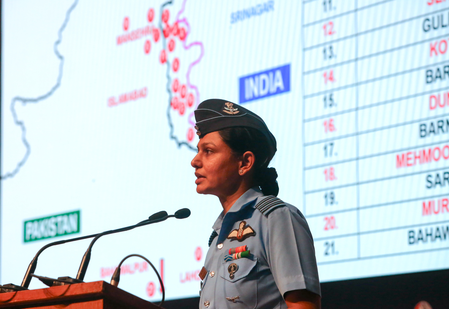
This attack led to Operation Sindoor, during which the Indian armed forces destroyed terrorist camps not just in PoK but deep inside Pakistan also. India called out Pakistan’s nuclear bluff and sent a loud message that any act of terror would be treated as an act of war and not a cross-border strike.
Counterterrorism experts say that the biggest lesson that India learnt years after the Mumbai 26/11 attacks is that fighting terror takes complete precedence when it comes to national security, especially when one has neighbours such as Pakistan.
Post the Mumbai 26/11 attacks, India witnessed a wave of blasts carried out by the Indian Mujahideen. However, once the outfit was wiped out, terror shifted largely towards Jammu and Kashmir, while the rest of the country remained quiet. Decisions such as the abrogation of Article 370 and the fall of separatism ensured development in Jammu and Kashmir. This led to the creation of jobs, and the youth were no longer willing to pick up arms to earn their money.
Although late, the Mumbai 26/11 attacks changed India’s perception when it came to its national security doctrine. To say that the threat is completely eliminated would be wrong.
Pakistan continues to back terrorists and is looking to rebuild networks.
Radicalisation drives have peaked, and adding to this headache are the latest waves of disinformation campaigns and honey-trapping incidents.
The fight would go on, but it is more important that India’s resolve remains strong and the doctrine keeps adapting to the new challenges posed by Pakistan and other state as well as non-state actors, an official said.