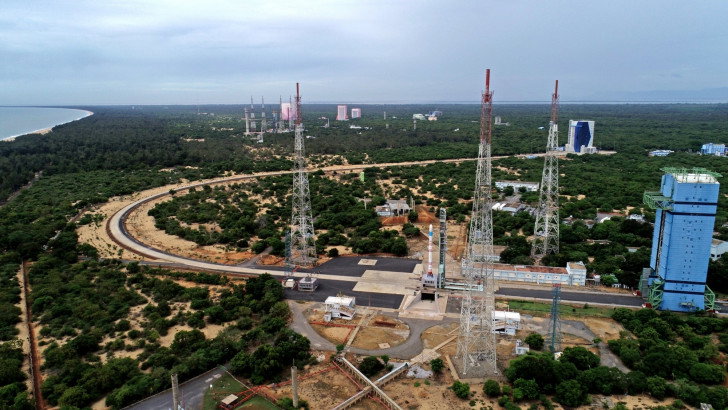
Sriharikota (Andhra Pradesh) Aug 7
The maiden launch of India's brand new rocket is keeping the country in suspense as to its fate on Sunday morning.
Hoping to celebrate in advance the country's 75th anniversary of Independence in style the Indian Space Research Organisation (ISRO) launched its freshly minted rocket Small Satellite Launch Vehicle - Developmental Flight (SSLV-D1).
On its first developmental flight, the SSLV-D1 carried an earth observation satellite-02 (EOS-02), formerly known as Microsatellite-2, weighing about 145 kg and the eight kg AZAADISAT built by 750 students of government schools facilitated by SpaceKidz India.
About 12 minutes into the rocket's flight, ISRO announced the separation of EOS-02 and the AZAADISAT.
However after that there was data loss, ISRO said leaving the nation in suspense.
"The AZAADISAT got separated. We can know about the satellite only at night," Dr. Srimathy Kesan, Founder and CEO, SpaceKidz India told IANS.
Speaking about the mission, ISRO Chairman S. Somanath said: "The SSLV-D1 mission was completed. All the stages of the rocket performed as expected. There is some data loss in the terminal stage of the rocket."
He said the data is being gathered to know the status of the mission.
At about 9.18 a.m. the rocket broke free of the first launch pad here and went up into a cloudy sky. The rocket's progress was smooth with all its solid fuel powered engines performing well.
The three-staged SSLV-D1 is primarily powered by solid fuel (total 99.2 ton) and also has a velocity trimming module (VTM) powered by 0.05 ton of liquid fuel for precise injection of satellites.
India's newest rocket is 34-metre tall and weighs 120 ton.
As per the flight plan, just over 12 minutes into its flight, the SSLV-D1 should deliver into space the EOS-2 satellite and then the AZAADISAT a few seconds later.
According to the ISRO, the SSLV is a ready to transfer rocket with modular and unified systems with standard interfaces for production by the industry.
The SSLV design drivers are low cost, low turnaround time, flexibility in accommodating multiple satellites, launch-on-demand feasibility, minimal launch infrastructure requirements and others, ISRO said.
The commercial arm of ISRO, NewSpace India Ltd plans to transfer the SSLV technology for production in the private sector.
The Indian space agency said the EOS-02 satellite is an experimental optical imaging satellite with high spatial resolution. The objective is to realise and fly an experimental imaging satellite with short turnaround time and showcase launch on demand capability.
Launch of small satellites will be a dominant factor in the global space sector with about 7,000 satellites expected to be up in the sky by 2027, V.K. Saraswat, member, Niti Aayog had said at a space seminar.
In all, about 7,000 small satellites are expected to be launched between 2018 and 2027 with a total value of $38 billion, Saraswat said.