








AMERICA
Threads of the Ghats

Kerala's Sericulture Sector
Kerala occupies a narrow strip of the south-western Malabar coast — 38,863 square kilometres wedged between the Western Ghats and the Arabian Sea, the twenty-second largest state in India by area and, since 1956, home to Malayalam-speaking districts merged into a single administration.
It is a state of superlatives on the human side of the ledger: the highest literacy rate in the country, the highest life expectancy, the highest sex ratio, and the highest Human Development Index of any Indian state as of 2024. Its economy leans on rubber and pepper, on coconut, tea, coffee, cashew and spices, and on remittances sent home by a long-standing Gulf expatriate community.
Silk does not appear on that list of specialities, and for good reason — Kerala produces a tiny fraction of India's raw silk. Yet it is, per person, one of the country's heaviest consumers of silk products, and the state government has spent three decades trying to close the gap between how much silk Keralites buy and how much the state actually grows and reels.
Kerala produces entirely bivoltine cocoons — a silk grown nowhere near the scale of Karnataka or Andhra Pradesh, but of a quality that punches above its weight.
Sericulture as a "Non-Traditional" Industry
Unlike the classic mulberry belts of the Deccan, sericulture in Kerala has always been treated as an activity the state deliberately promotes rather than one that grew up on its own.
The Rural Development Department oversees it, running schemes in pockets across all fourteen districts through the state agency SERIFED, with the most serious cultivation concentrated in the high-range areas of Wayanad and Thiruvananthapuram, and in pockets of Idukki and Palakkad.
The payoff has been slow but real. Cocoon production climbed from 31 metric tonnes in 1995–96 to 104 metric tonnes in 2023–24 — the highest figure the state has ever recorded — and every cocoon produced is bivoltine, a hardier, more uniform silkworm race that yields a higher silk ratio than the multivoltine strains more common in warmer plains.
Silk isn't even the largest thread in Kerala's textile story. The handloom sector — the state's second-largest traditional industry after coir — is bigger by far, with about 42% of Kerala's handloom weavers based in Thiruvananthapuram district and Kannur in the north running a close second, its looms turning out cloth largely destined for export.
Who Runs It, and Who Farms It?
The state formalised its approach in 2014, when the Government of Kerala set up a Directorate of Sericulture inside the Commissionerate of Rural Development and named the Commissioner for Rural Development as the state's Director of Sericulture.
Day-to-day delivery runs through the Local Self Government Department and the three-tier Panchayati Raj system — jilla, block and grama panchayats — with a Deputy Director of Sericulture and a team of Assistant Sericulture Officers providing the technical backbone.
Five Years of Raw Silk, in Numbers
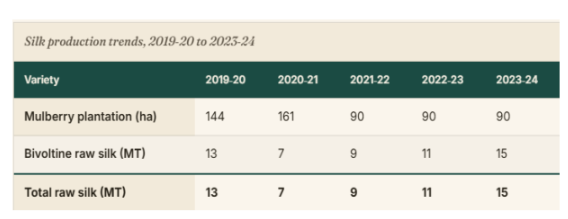
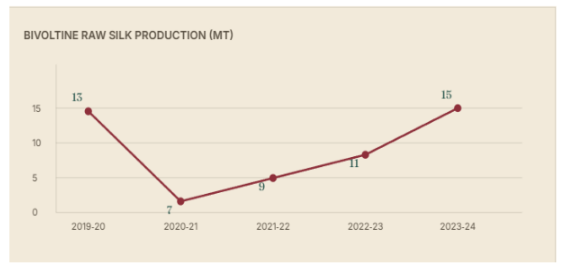
Mulberry acreage has actually shrunk over the past five years — from 144 hectares in 2019–20 to a steady 90 hectares since 2021–22 — yet raw silk output has moved the other way, more than doubling from 7 metric tonnes at the 2020–21 low to 15 metric tonnes in 2023–24.
That combination points to better yields per hectare rather than expansion of the growing area, likely the payoff of the plantation-development and quality-disinfectant schemes described further down.
Three Districts Carry the Whole Harvest
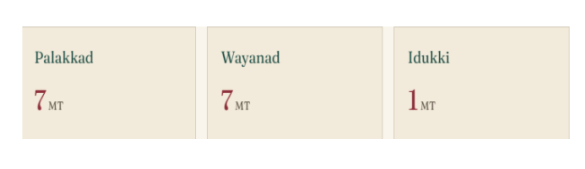
Of the 15 metric tonnes of raw silk Kerala produced in 2023–24, essentially all of it came from just three districts.
Palakkad and Wayanad each contributed 7 tonnes, with Idukki adding a single tonne — a geography confirmed by district-level mapping, which shows Palakkad as the only district in the 0.68–9.93 MT production band, with Wayanad, Idukki and Kannur trailing well behind it and most of the state, from Thiruvananthapuram in the south to Kasargod in the north, growing no mulberry at all.
Sixty Years of State Investment
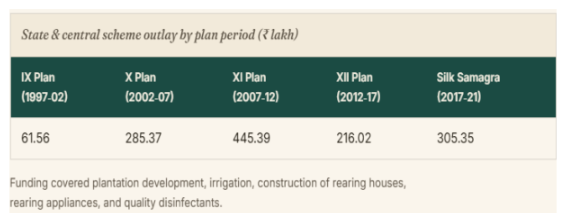
Kerala's push into sericulture has been funded in waves tied to India's Five-Year Plan cycles, running from the IX Plan (1997–2002) through to the Silk Samagra scheme that closed in 2021.
Spending peaked during the XI Plan (2007–12), when the state committed over ₹4.4 crore to the sector, before tapering in the plan periods that followed.
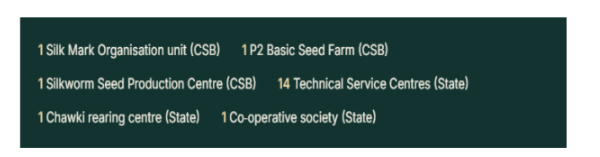
That money built out a supporting infrastructure shared between the central and state governments. The Central Silk Board maintains a Silk Mark Organisation of India unit in the state, alongside a P2 Basic Seed Farm and a Silkworm Seed Production Centre.
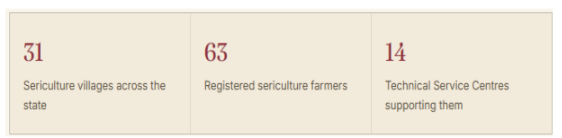
The state's own Sericulture Department runs 14 Technical Service Centres, one Chawki rearing centre for young silkworms, and one farmers' co-operative society.
Kerala's Place on India's Silk Map
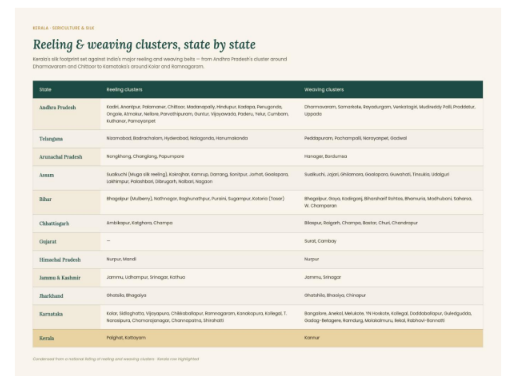
Set against India's major reeling and weaving belts — Andhra Pradesh's cluster around Dharmavaram and Chittoor, Karnataka's around Kolar and Ramnagaram, and Assam's muga-silk hub at Sualkuchi — Kerala's presence is modest but real.
Palghat (Palakkad) and Kottayam register as the state's reeling clusters, while Kannur, already the state's second handloom hub, does double duty as its weaving cluster.
Where the Next Mulberry Could Grow
With production this concentrated, the state's clearest path to growth is mapping the land it hasn't planted yet.
The Kerala State Remote Sensing and Environment Centre, working with the North Eastern Space Applications Centre and funded by the Central Silk Board, carried out suitability surveys in the two districts seen as having the most untapped potential: Wayanad and Thiruvananthapuram.
Wayanad — Altitude on Its Side
Formed in 1980 by carving territory out of Kozhikode and Kannur, Wayanad sits at 700 to 2,100 metres in Kerala's north-east, headquartered at Kalpetta, with roughly 886 square kilometres of the district under forest cover.
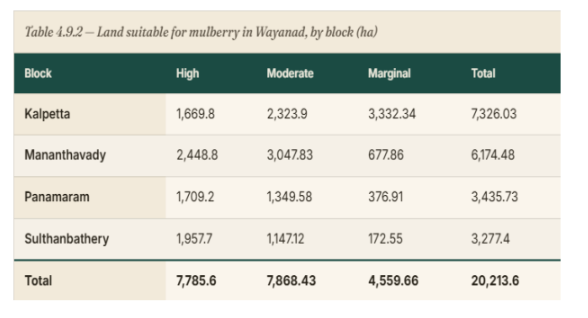
The suitability survey, run block by block across Kalpetta, Mananthavady, Panamaram and Sulthan Bathery, found a substantial amount of land in the "highly suitable" and "moderately suitable" categories.
Nearly 7,800 hectares rate as highly suitable — territory concentrated in Mananthavady and Sulthan Bathery — against 90 hectares of mulberry the whole state currently cultivates.
The gap between what's grown and what could be grown is the clearest single number in the case for expansion.
Thiruvananthapuram — A Smaller, More Marginal Opportunity
The capital district tells a more constrained story.
Home to the state's most populous city (957,730 people at the 2011 census) and a major IT hub contributing 55% of Kerala's software exports as of 2016, Thiruvananthapuram's terrain of undulating coastal hills leaves comparatively little room for mulberry.
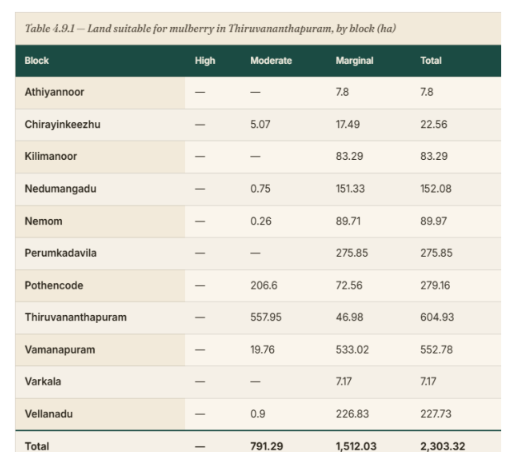
Across its eleven blocks, the survey found no land rated highly suitable at all — only pockets of moderate and marginal potential, concentrated around Pothencode and the Thiruvananthapuram block itself.
Put side by side, the two surveys make the same point from different angles: Wayanad has both the altitude and the acreage to become Kerala's real mulberry frontier, while Thiruvananthapuram's role is likely to stay supplementary — useful for a state trying to diversify a supply chain currently resting on three districts, but never a substitute for the hills in the north.
A Minor Crop, Deliberately Grown
Nothing about Kerala's sericulture sector is accidental scale — every hectare under mulberry, every tonne of bivoltine cocoon, is the product of a state government treating silk as a policy choice rather than a legacy industry.
Three decades of plan-period funding have produced a record cocoon harvest but a still-tiny raw silk output; a district-level suitability survey has now mapped tens of thousands of untapped hectares in Wayanad alone.
Whether that potential becomes production will depend less on the land than on whether the next funding cycle matches the ambition of the mapping that preceded it.
Sources and Compilation
Compiled from state sericulture and district profile data covering Kerala's Directorate of Sericulture, silk production trends (2019–24), Central Silk Board infrastructure, national reeling/weaving cluster data, and mulberry suitability surveys for Wayanad and Thiruvananthapuram districts.


