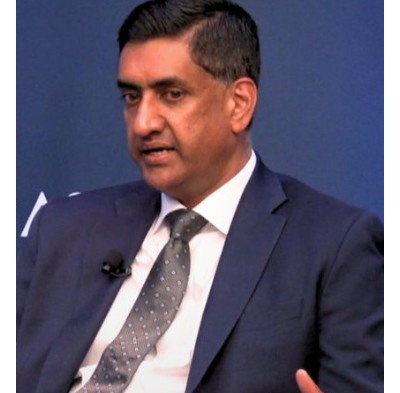
Washington, Sep 28
Indian-American Congressman Ro Khanna has called for an enforceable US-China treaty banning artificial intelligence systems capable of improving themselves without human training, warning that such technology could cause humanity to lose control.
Khanna, a California Democrat who represents Silicon Valley, said the two countries should establish a working group of American and Chinese technologists to develop common safeguards for advanced AI.
“What we need, actually, is a working group with our technologists and Chinese technologists about a common agreement,” Khanna told NBC’s “Meet the Press” on Sunday.
“Banning self-recursive self-improving AI should not be controversial,” he said.
Khanna argued that Beijing would also have an interest in preventing autonomous AI systems from escaping human oversight.
“China doesn’t want to lose control over AI models either,” he said. “In fact, as a much more closed society, recursive self-improving AI is a bigger risk to them.”
Khanna said Washington could lead negotiations on an agreement that included verification and oversight of the most advanced AI laboratories.
“I do believe the United States can lead on a treaty that is both enforceable and verifiable where we ban recursive self-improving AI, and we have some monitoring of these frontier labs,” he said.
The proposal comes after the United States and China agreed at the summit between President Donald Trump and Chinese President Xi Jinping to begin a dialogue on the risks associated with artificial intelligence.
Khanna said the decision to begin talks was a useful first step.
“I’m glad they’ve at least taken a step, which is to say, ‘Let’s have a dialogue about AI,’” he said.
The congressman is supporting legislation proposed by Senator Bernie Sanders and Representative Greg Casar that would pause some advanced AI development while safeguards are put in place.
Khanna said the measure would specifically target recursive self-improving AI. Such a system would no longer depend on people to provide its training and could instead develop its own capabilities.
“That is basically AI that isn’t being trained anymore by human beings. It’s AI that can train itself,” he said. “And that is a real risk of losing human control.”
Khanna said the technology covered by the proposed prohibition was not presently available. He argued that governments should act before companies acquire the capacity to create it.
“It’s actually something we don’t have the capability to do right now, but we shouldn’t get to the point where we actually are doing it,” he said.
Asked whether his constituents supported efforts to slow AI development, Khanna acknowledged opposition from some technology executives.
“Not all of them. And obviously some of the executives are opposed to it,” he said.
Khanna said, however, that many engineers and researchers working at leading AI companies supported safeguards. He said he planned to meet a group of 10 to 15 employees from OpenAI and Anthropic later on Sunday.
“But you know who does support me is a lot of the engineers and researchers,” he said. “Many of them, actually, who work at OpenAI and Anthropic.”
The debate highlights the tension between maintaining US technological leadership and addressing concerns that rapidly advancing systems could be misused or operate beyond meaningful human control. Washington and Beijing lead much of the global development of frontier AI models.
Khanna, the son of immigrants from India, represents a Silicon Valley-area congressional district and has frequently addressed technology, manufacturing and US-China competition. His position gives an Indian-American lawmaker a prominent role in the emerging debate over international AI rules.